Journal Prizes: Best Article by an Early Career Entomologist
Our journal awards, given out by each of our eight journals, are designed to celebrate excellent research by Early Career Entomologists in the specific fields covered by our journal portfolio.
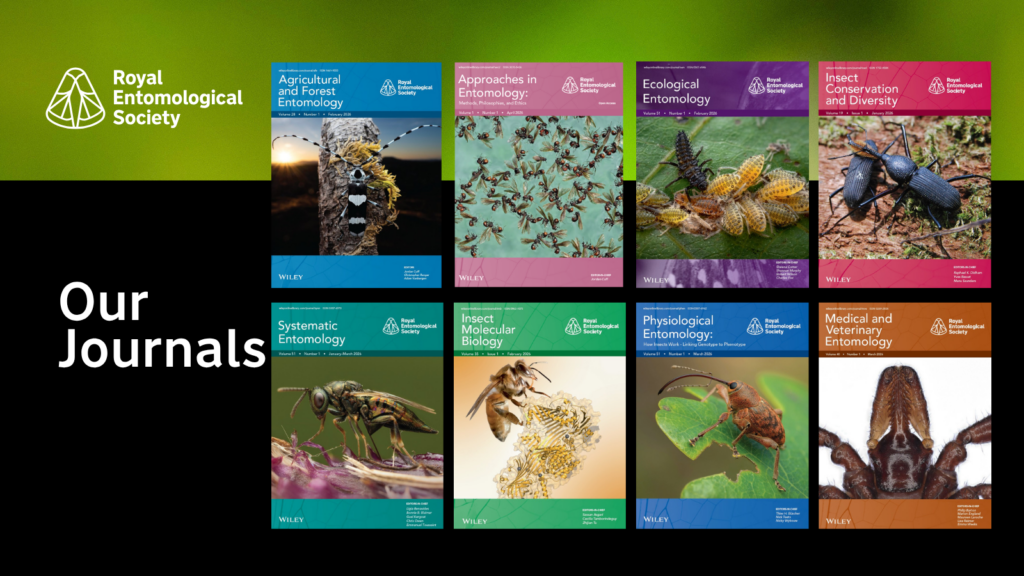
The Royal Entomological Society has a history of awarding best paper prizes, and from 2024 the RES journal awards honour early career entomologists publishing in our journals.
We hope that recognising the best work led by early career entomologists in our journals we can support the career development of these authors and highlight the fantastic research published in RES journals.
Submit your work
Submit to RES journals to have your work considered for future journal awards.
RES Journal Awards at a Glance
| Prize | £200
Guarenteed talk at Ento, the Royal Entomological Society’s annual conference
Free RES Membership for one year |
| Purpose |
Support the career development of early career entomologists.
|
| Eligibility | Early career lead authors of articles published in the last volume of RES journals. |
| Deadline | tbc |
| Decision body | RES Journal Editors |
Award Guidance
Award Criteria
Lead early career authors of articles published in the last volume of RES journals are eligible for the prizes.
Early career is defined as researchers within ten years of completing their undergraduate degree or with less than ten years working in entomology in any capacity, with or without a degree. Time for career breaks is not counted in the 10 year time period.
Selection, and Assessment Criteria
Eligible articles are automatically entered for this award upon publication in a RES Journal.
The Editor-in-Chief for each journal assesses all eligible articles based on whether they are topical, have a broad interest, are well communicated and in an area of interest for the journal. One winner is selected per RES journal. Editors may also select articles for Special Commendation.
Key Dates
Articles published in the current volumes of RES Journals will be eligible, and announced in 2027.
Prize and Recognition
Winners receive
- £200
- Guarenteed talk at Ento, the Royal Entomological Society’s annual conference
- Free RES Membership for one year
Winning entries are publicised through a special edition RES jounal, and on the RES website.

Previous Winners
Winners – for best articles with Early Career Entomologists as lead authors published during 2025
Read more about this year’s winners here, and read all the 2025 winning and highly commended articles in this Virtual Issue.
Winners – for best articles with Early Career Entomologists as lead authors published during 2024
Read more about this year’s winners here, and read all the 2024 winning and highly commended articles in this Virtual Issue.
Winners – for best papers with Early Career Entomologists as lead authors published during 2021-2023
Read more about this year’s winners here, and read all the 2021-2023 winning and highly commended articles in this Virtual Issue.
Winners – for best papers published during 2019-21
Read more about this year’s winners here, and read all the 2021 winning articles in this Virtual Issue.
Winners – for best papers published during 2018-19
Agricultural and Forest Entomology – Agricultural and Forest Entomology, 20 (3), 390-401, 2018.
Xiaohong Li, Michael Garvey, Ian Kaplan, Baoping Li, Juli Carrillo – Domestication of tomato has reduced the attraction of herbivore natural enemies to pest-damaged plants
Ecological Entomology – Ecological Entomology, 43 (2), 168-181, 2018.
Dave Goulson, Steph O’Connor, Kirsty J. Park – The impacts of predators and parasites on wild bumblebee colonies
Insect Conservation and Diversity – Insect Conservation and Diversity,11 (1), 1-12, 2018.
Laurence Packer, Spencer K. Monckton, Thomas M. Onuferko, Rafael R. Ferrari – Validating taxonomic identifications in entomological research
Insect Molecular Biology – Insect Molecular Biology, 27 (3), 352-364, 2018.
Y. Zhang, K. Feng, J. Hu, L. Shi, P. Wei, Z.Wu, G. Shen, M. Li, Q. Wu, L. He – A microRNA=1 gene, tci-miR-1-3p, is involved in cyflumetofen resistance by targeting a glutathione S-transferase gene, TCGSTM4, in Tetranychus cinnabarinus
Winners – for best papers published during 2017-18
Medical and Veterinary Entomology – Medical and Veterinary Entomology, 31, 365-372, 2017.
M. Brustolin, S. Talavera, A. Nunez, C. Santamaria, R. Rivas, N. Pujol, M. Valle, M. Verdun, A. Brun, N. Pages and N. Busquets – Rift Valley fever virus and European mosquitoes: vector compettence of Culex pipiens and Stegomyia albopicta (= Aedes albopictus)
Physiological Entomology – Physiological Entomology, 42, 181-190, 2017.
Lily M. Thompson, Trevor M. Faske, Nana Banahene, Dominique Grim, Salvatore J. Agosta, Dylan Parry, Patrick C. Tobin, Derek M. Johnson and Kristine L. Grayson – Variations in growth and developmental responses to supraoptimal temperatures near latitudinal range limits of gypsy moth Lymantria dispar (L.), an expanding invasive species
Systematic Entomology – Systematic Entomology, 42, 267-287, 2017.
Camiel Doorenweerd, Erik J. Van Nieukerken and Robert J. B. Hoare – Phylogeny, classification and divergence times of pygmy leaf-mining moths (Lepidoptera: Nepticulidae): the earliest lepidopteran radiation in Angiosperms?
Winners – for best papers published during 2016-17
Agricultural and Forest Entomology – Agricultural and Forest Entomology, 19 (1), 101-112, 2017.
Sarah L. Facey, David B. Fidler, Rhiannon C. Rowe, Lisa M. Bromfield, Sabine S. Nooten, Joanna T.Staley, David S. Ellsworth and Scott N. Johnson – Atmospheric change causes declines in woodland arthropods and impacts specific trophic groups.
Ecological Entomology – Ecological Entomology, 42 (2), 105-114, 2017.
Tom R. Bishop, Mark P. Robertson, Berndt J. Van Rensburg and Catherine L. Parr – Coping with the cold: minimum temperatures and thermal tolerances dominate the ecology of mountain ants.
Insect Conservation and Diversity – Insect Conservation and Diversity, 9 (6), 574-584, 2016.
Alessandro Campanaro, Livia Zapponi, Sönke Hardersen, Marcos Mendez, Nida Al Fulaij, Paolo Audisio, Marco Bardiani, Giuseppe M. Carpaneto, Serena Corezzola, Francesca Della Rocca, Deborah Harvey, Colin Hawes, Marcin Kadej, Jerzy Karg, Markus Rink, Adrian Smolis, Eva Spencer, Arno Thomaes, Ilaria Toni, Al Vrezec, Agnese Zauli, Michelle Zilioli and Stefano Chiari – A European monitoring protocol for the stag beetle, a saproxylic flagship species.
Insect Molecular Biology – Insect Molecular Biology, 25 (3), 315-323, 2016.
K. Cappelle, C.F.R de Oliveira, B.Van Eynde, O. Christiaens and G. Smagghe – The involvement of clathrin-mediated endocytosis and two Sid-1-like transmembrane proteins in double-stranded RNA uptake in the Colorado potato beetle midgut.
Have you received a RES Award or Grant?
