First published: 16 July 2025
A recent article published in RES journal, Systematic Entomology, highlights the evolution of the Zodariidae spider family globally. The article, ‘Phylogenomics unveils Afrotropical origin, trans-oceanic global diversification and climatic niche conservatism in the sedentary Zodariidae ant spiders‘, analysed data from approximately 1,000 genes to reconstruct the relationships of the entire family (commonly known as ant spiders), which occurs worldwide. In recent years, the availability of such large genetic datasets has revolutionized our understanding of the evolution of various groups by providing highly reliable inferences, but for most organisms (including spiders) these studies remain scarce (and costly).
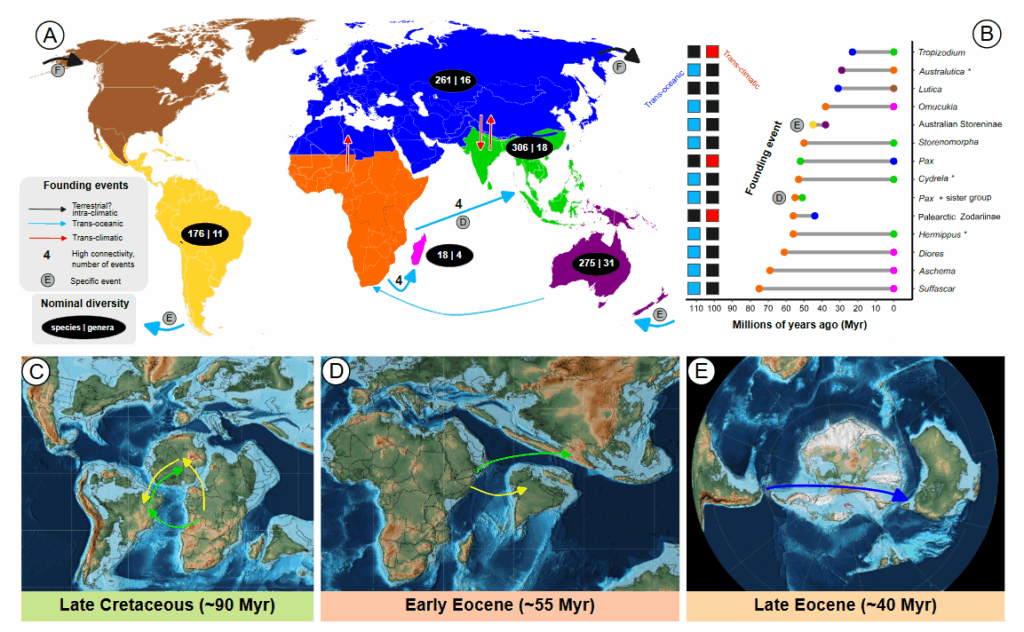 Trans-oceanic global diversification of ant spiders – Map images showing the main founding events that shaped worldwide distribution of Zodariidae and diversity of the family across biogeographic regions
Unlike other spiders, zodariids lack airborne dispersal (ballooning) and have no known alternative active mechanism for over-water dispersal. In such groups of poor dispersers—which also include tarantulas—a global distribution is typically attributed to ancient origins when Earth’s primary landmasses were united as Pangaea, or later Gondwana in the south and Laurasia in the north.
The authors’ analyses revealed with high confidence that ant spiders originated and diversified only after these continental landmasses had already split, making over-water dispersal necessary to explain their current worldwide distribution. Their biogeographic analyses clearly demonstrate at least 22 colonization events across biogeographic realms, 14 of which have well-supported routes; of these, 10 required trans-oceanic crossings. Surprisingly, only four events occurred between regions with terrestrial connections, indicating that trans-oceanic dispersal was far more common than terrestrial movement—a counterintuitive result.
This pattern arises indirectly because terrestrial dispersal between realms often requires trans-climatic transitions (e.g., from tropical to temperate regions or vice versa), which zodariids rarely managed. Such shifts likely demand substantial physiological and ecological adaptations that seldom occurred in the group’s history. Therefore, it was much easier for zodariids to cross oceans and establish in similar environments elsewhere than to adapt to novel environments without crossing water.
Although trans-climatic transitions were infrequent, one such event was highly successful, giving rise to the diverse Palaearctic ant-eating spiders (over 200 species) from an Afrotropical ancestor. This finding aligns with theories proposing that release from ecological constraints can trigger significant species radiations.
This leaves the question of how zodariids crossed oceans without any clear dispersal mechanism. The most plausible hypothesis is rafting on natural debris, such as tree logs, which can be carried long distances into open oceans via river systems, turning plants and animals trapped on them into long-distance voyagers.
Among the most influential trans-oceanic events were colonisations of Australia, which appear to have originated from a single South American ancestor that arrived around 40 Ma—most likely by island hopping via Antarctica, which was still partially vegetated at the time. While most colonization routes occurred only once, there were at least four events from Africa to Madagascar (unsurprising given their proximity) and four between Africa and East Asia, likely facilitated by stable ocean currents over millions of years.
“It was especially surprising that the vast majority of Australian ant spiders descend from a single ancestor that migrated from South America via Antarctica when it was still largely unfrozen”
– David Ortiz, first author
Ultimately, the study exemplifies how organisms can surmount seemingly insurmountable barriers—like oceans—given sufficient time (millions of years), whereas ecological barriers that are less visible can sometimes prove more challenging. They also suggest that many other organisms with low dispersal capacities and worldwide distributions, which have been assumed to predate continental breakup, may share life histories similar to ant spiders, having arisen from ancestors capable of traversing oceans.
Contact David on Bluesky @davidortizm.bsky.social or Twitter/X @davidortiz_m.
Systematic Entomology now accepts articles on arachnids (excluding mites) and myriapods. For more information, see here.
Want to be featured in our Journal Highlights?
Shine a spotlight on your research by submitting your papers to any of our seven journals for the chance to be mentioned on our news pages and social media
Follow us on social media for updates and share your insect news and events using @royentsoc
