First published: 07 August 2025.
Urbanization is rapidly expanding worldwide, posing a significant threat to biodiversity through habitat loss, fragmentation, and degradation. To counter these negative effects, restoring sufficient interconnected green spaces is crucial. One promising solution is an urban green infrastructure network including green roofs. Despite being promoted for their ecosystem services and habitat connectivity, the actual contribution of green roofs to biodiversity, especially for insects, is debatable.
In a review published in Insect Conservation and Diversity, “The development of insect diversity and ecosystem complexity on green roofs: a review,” Drukker et al. challenge current thinking in green roof design through an ecological perspective on green roof development, highlighting the importance of insects.
Green roofs can be categorized into Sedum roofs, nature roofs, and roof gardens, each supporting arthropod diversity in different ways. Plant diversity—shaped by factors like water availability and substrate depth—is a primary driver of arthropod diversity. Other factors such as roof height, size, and proximity to surrounding green space also play a role, though findings are often inconsistent, likely due to low replication and high variability among roofs.
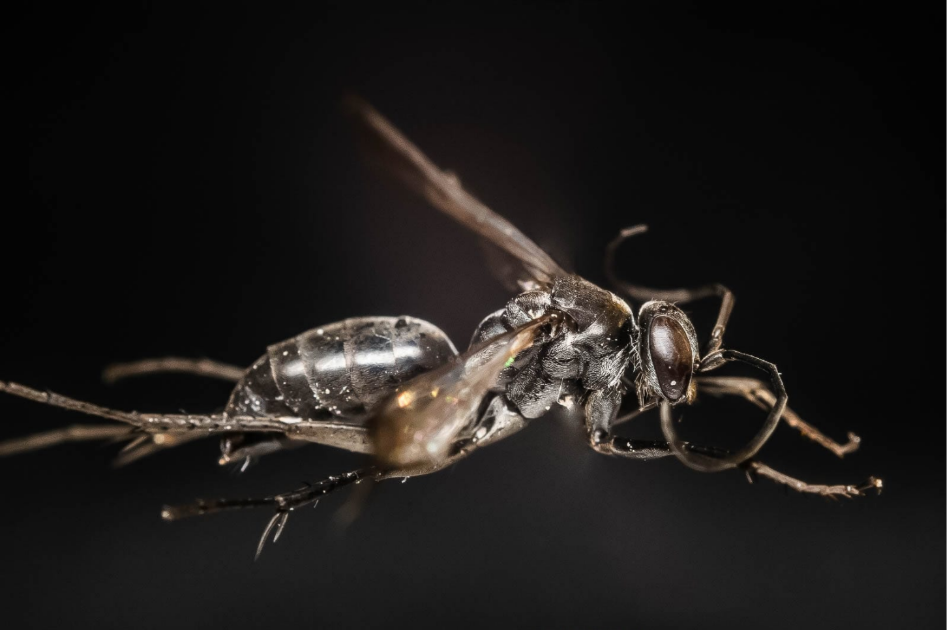 Agenioideus sericeus: Agenioideus sericeus, species of wasp found on a green roof inventory, Amsterdam 2018.
Picture taken by Cas van den Bomen.
Arthropods are important indicators of green roof performance due to their key role in ecosystems. Investigating their establishment helps determine whether green roofs provide suitable conditions for reproduction, lifecycle completion and long-term persistence.
Long-term monitoring of arthropod establishment will reveal patterns of succession and ecosystem development over time.
In the early stages of a green roof’s development, stochastic processes such as colonization, extinction, and priority effects play a dominant role. These processes are largely influenced by the surrounding landscape and the availability of colonizers. Understanding the randomness in colonization allows for strategic interventions, such as designing the roof to attract desired species or creating suitable conditions for specific keystone species.
As the ecosystem develops, deterministic factors such as substrate depth, water availability, and species interactions become more influential. These factors create environmental filters that determine which species can survive and thrive. With their thicker substrates, diverse vegetation, and native plants, nature roofs and roof gardens have a higher potential to provide stable, biodiverse ecosystems that are less impacted from external (stochastic) factors and offer numerous ecological and societal benefits. This would make them a preferred choice for projects aiming to maximize the biodiverse green roof ecosystems. These roof types are scarce however and more research is needed to better understand their ecological functioning and long-term development.
This review aims to inform landscape planning, design, management, and policy how to build towards a more biodiverse green roof landscape in cities. This approach aligns with the EU Biodiversity Strategy for 2030, advocating for the strategic use of blue and green infrastructure to enhance urban biodiversity.
“It is remarkable and inspiring to see the growing interest in green roofs from people beyond the field of ecology – especially their commitment to enhancing biodiversity, which is why it is important for us as ecologists to provide the knowledge and tools they need to achieve this.”
– Eva Drukker
Want to be featured in our Journal Highlights?
Shine a spotlight on your research by submitting your papers to any of our seven journals for the chance to be mentioned on our news pages and social media
Follow us on social media for updates and share your insect news and events using @royentsoc
