It’s Peer Review week (15-19 September 2025) and the perfect opportunity to say thank you to all the reviewers from across the world who review for our journals.
As a Learned Society, we value the time and effort of reviewers beyond measure. Like many Learned Societies, our journals provide a vital source of income and, by reviewing for us, as well as being a vital part of the publishing process, reviewers help the Royal Entomological Society invest in meaningful entomology that supports the understanding, development and future of insect science. All reviewers in our journals receive certificates acknowledging their contribution; it is important that we recognise the time and effort it takes to produce a good review.
We also feel it is important to support the next generation of reviewers. In a world with mounting time pressures, a rapidly evolving publishing landscape, and the increasing use of AI in academia, it is vital that we ensure that reviews for our journals are still done ethically, robustly and constructively by humans and for humans.
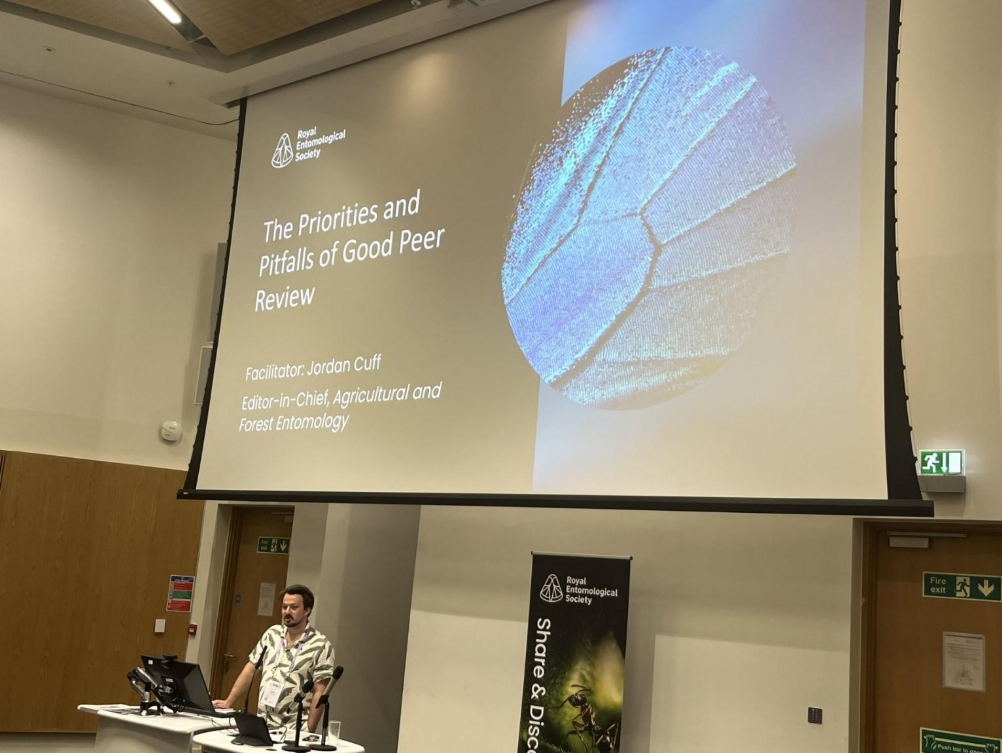 Jordan Cuff explaining the RES Open Data Policy and how to check data effectively when writing a review.
But how do you learn to be a good reviewer?
At our recent annual conference, Ento25, Dr Jordan Cuff, co-Editor-in-Chief of the journal Agricultural and Forest Entomology (AFE), ran a workshop entitled “The Priorities and Pitfalls of Good Peer Review”. This was a practical session for researchers interested in improving their peer review skills. Attendees learned how to read and assess scientific articles, write constructive and useful review reports, and navigate the review and editorial process.
They also heard from other RES journal editors to find out about different roles in the peer review process, including Sheena Cotter (EiC of Ecological Entomology), Larissa Collins (Associate Editor of Agricultural and Forest Entomology) and Max Tercel (Associate Editor of Insect Conservation and Diversity and Editorial Board Member of Agricultural and Forest Entomology).
It wasn’t all listening, though: attendees were given a variety of mini ‘papers’ to review themselves, working in groups and voting on what decision they would recommend to the editor if they were doing the peer review, and feeding back to the room on what key issues they had highlighted in their mini reviews. Thinking constructively about how to make each paper better, checking the articles against the scope of the journal and author guidelines, and ensuring the authors had a positive experience were all part of the workshop.
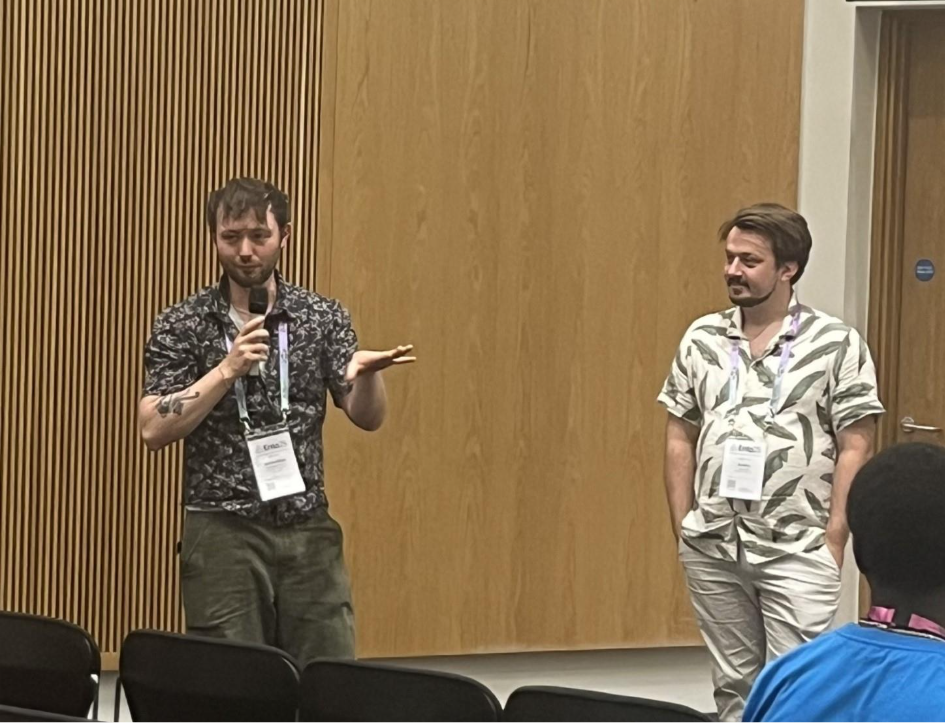 Max Tercel explaining how to build your career to become a regular reviewer, editorial board member and eventually associate editor.
In an exciting finale to the workshop, the AFE Early Career Peer Review College was also announced.
This will be an opportunity for entomologists early in their career to learn how to review for AFE whilst being guided through the process, given training through workshops and webinars, and offered bespoke feedback on improving their reviews. It is the hope that these ECR reviewers will become excellent reviewers for RES and other journals, – and maybe even the editorial board members or editors – of the future.
“Peer review is one of the most crucial pillars of the scientific process, governing which research is published and in what state. We hope that the peer review workshop demystified this process, provided some useful tips and tricks for those looking to start and delivered some light practice through the short mock papers.
The launch of the Peer Review College for Agricultural and Forest Entomology marks an exciting next step in the RES’ capacity for training the next generation of exceptional peer reviewers.”
– Dr Jordan Cuff, co-Editor-in-Chief of the journal Agricultural and Forest Entomology (AFE)
If you are interested in applying for a place on the AFE Early Career Peer Review College, please email jayne@royensoc.co.uk to find out more.
Want to be featured in our Journal Highlights?
Shine a spotlight on your research by submitting your papers to any of our seven journals for the chance to be mentioned on our news pages and social media
