In line with the Royal Entomological Society’s devotion to the understanding and development of insect science, we increasingly recognise the vital role that open research can play in delivering our goals. Our support for international collaboration, research and publication is strengthened by advocacy for open research practices. We aim to show every person how remarkable and valuable insects are as openly as possible through the robust and rigorous research published in our journals.
Here, we define a long-term roadmap and strategy for the RES’ commitment to open research.
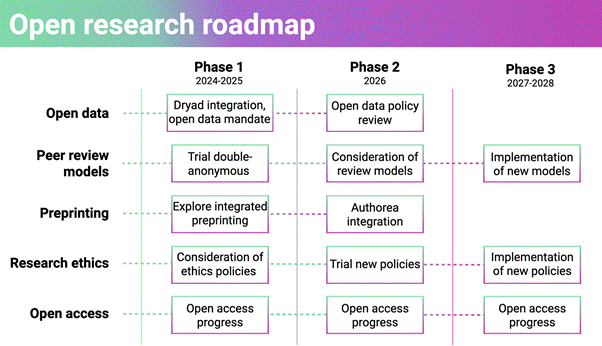 A roadmap of open research implementation by the RES.
A recent article collaboratively prepared by RES Publications Committee members and journal Editors-in-Chief outlines the practical and ethical imperatives for adopting open research practices across entomology. This article also highlights the holistic nature of open research across the research lifecycle with explicit examples of practices at every stage. Most crucially, the article also states that publishers, including scholarly societies, must take responsibility and leadership in the open research transition. This can be achieved through advocacy, encouragement and mandating, but must be proactive.
We have defined a multi-year strategy to deliver this for the RES.
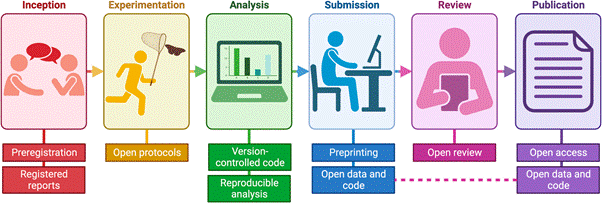 The open research practices highlighted by Cuff et al. (2024).
Phase 1 (2024-2025)
Open data
The open sharing of data and code is paramount for community-wide advances across insect science and is one of the key hallmarks of transparent and open research. RES journals now mandate all data to be made available publicly at the point of publication. In addition, we require all authors to make data available either privately for peer review, or publicly, at revision stage, so that editors and/or reviewers can assess the data to ensure it is reusable. We adhere to the principle ‘as open as possible, as closed as necessary’ and are happy to make exceptions or offer embargos as needed. Full details of our policy can be found here. To facilitate this, we cover the cost for RES authors to deposit their data with Dryad. Authors are welcome to deposit their data with any repository that meets our guidelines; however, we recommend Dryad since they offer enhanced curation and discoverability and additional support for authors. We hope that by covering this cost for our authors, we have made it as straightforward as possible to adhere to our policy.
Peer review
Peer review is key to the publication process and we are keen to ensure that our processes support rigour and reproducibility in published outputs. Open review can encourage collegiate and constructive review processes whilst also providing recognition to reviewers for their valuable contribution to publishing. We are currently trialling double anonymous review in Ecological Entomology; whilst this may appear counter to the transparency of open research, evidence shows that this mitigates biases and inequities in the publishing process. We will therefore consider extending this to our other journals. We will also look at other innovations and improvements in our peer review processes, including open review options.
Research ethics
Entomological research often harms or disturbs insects, but these harms can be limited through best practice. In line with ongoing progress furthering the representation of invertebrates in welfare contexts, the RES will consider practical ways to promote good ethical practices in our editorial policies, including the consideration of optional ethics statements.
Global inequities have been exacerbated for centuries by colonial approaches to research, often referred to as ‘helicopter science’, in which resources or study systems are used without appropriately involving or acknowledging contributions from local communities, people or scientists. Medical and Veterinary Entomology is currently trialling a policy to address this, asking authors to include reflexivity statements where appropriate. We will consider future updates to this policy and wider rollout. By including statements confirming best practice in this regard in publications, the RES will incentivise best practice.
Phase 2 (2026)
Open data
We will continue to review our open data policy to ensure it is best serving our authors and wider community. Feedback on this is welcome.
Research ethics
The ethics statements to be considered in Phase 1 will facilitate reflection on the harms caused by research, but it is only through mandating such statements that this will be assured and best practice maintained. We will monitor the reception of initiatives implemented in Phase 1 and strengthen these as required. Ideally, we would like to encourage all researchers to consider ethical issues throughout their research, rather than solely at the point of publication, and we hope that well-promoted public policies in these areas will catalyse this.
Preprinting
Whilst all of our journals are already compatible with preprinting, we will further encourage engagement through integration of preprinting into our journal submission processes through Authorea. By streamlining preprinting within our submission portals, we will encourage early access to and appraisal of research. Alongside documented benefits to citation rates and other publishing metrics, this will also generate tangible outputs for researchers earlier in the publishing process, particularly important for early career researchers.
Open access
We will embrace the ongoing transition toward open access publishing for selected journals based on their existing open access submission rates. Based on existing rates of open access publication by authors, we will trial open access publishing models with selected journals and closely monitor uptake to ensure that it is of benefit to the RES author community.
At its core, this change will be designed to increase access to publications without hindering access to publishing. This will therefore be evidence-based and pragmatic with consideration of our author community central to its execution. Measures will therefore be put in place to ensure that global inequities do not prohibit authors from the Global South from publishing.
Phase 3 (2027-2028)
Open review
Alongside the ongoing transition toward double-anonymous review, we will take a considered approach toward the implementation of open review. Open review can be compatible with double-anonymous review through a variety of review models. We will take a cautious approach to the introduction of open review based on published evidence and the needs of our author and reviewer communities. By integrating this into the RES publishing process, it is hoped that the quality and benefits of reviews will increase for both authors and reviewers, and that the value that they provide in contextualising published research will be maximised.
Other open science initiatives
Our Open Science Working Group will continue to assess open science initiatives in the coming years to serve the entire entomological community, without adding undue burden to our authors. New developments are happening all the time and we look forward to showing leadership in this area.

Want to be featured in our Journal Highlights?
Shine a spotlight on your research by submitting your papers to any of our seven journals for the chance to be mentioned on our news pages and social media
