Grand Challenges In Entomology is an ongoing project of the Royal Entomological Society to develop an agenda for the future of global entomology and for the Society. It is guided by the publication Grand challenges in entomology: Priorities for action in the coming decades in RES journal Insect Conservation and Diversity
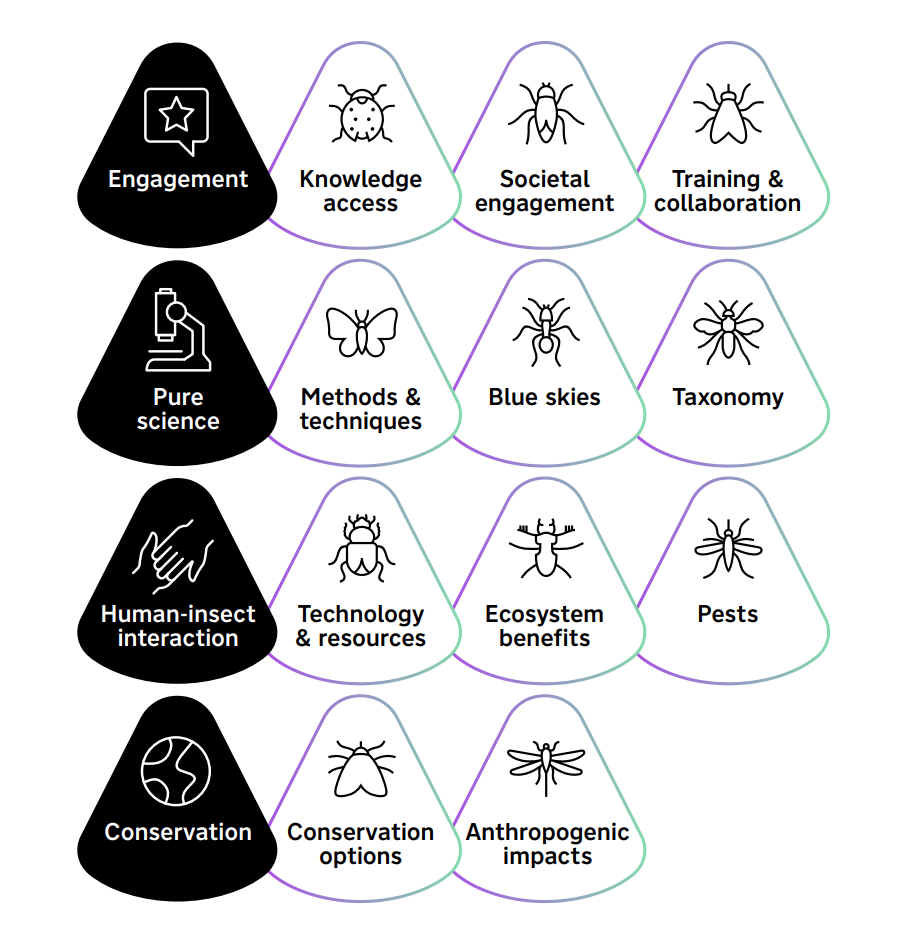
After a large membership consultation and expert workshop, eleven themes were determined to group the scientific priorities in insect science. This prioritisation exercise was led by Prof. Lynn Dicks at the University of Cambridge and RES Trustee, to focus the Society’s global membership on the future of the entomological sector and its crucial role providing global solutions.
Outputs from this project will include scientific papers, themed meetings and awareness campaigns over the next five or more years.
The eleven themes identified are:
| Taxonomy | Blue Skies | Methods and Techniques |
| Anthropogenic Impacts | Conservation Options | Ecosystem Benefits |
| Technology and Resources | Pests | Knowledge Access |
| Training and Collaboration | Society Engagement | |
Grand Challenges In Entomology
Prioritising shortlisted challenges
The final prioritisation took place during an online workshop conducted on 21 and 22 July 2021. Before the workshop, collated results were shared with participants in spreadsheet form, with voter identities anonymised. The challenges that received the most votes within each theme were proposed for discussion in the workshop, but each participant had the opportunity to reinstate low voted ‘wildcards’ for discussion. Participants were asked to prepare to introduce between two and four of the top-voted suggested challenges during the workshop, to open discussions about each suggestion.
Final priority challenges within each theme can be found below:
| Taxonomy |
| Funding for taxonomy: increase funding to support taxonomy and species descriptions, especially in regions with large proportions of undescribed fauna |
| Early career development: provide opportunities for the early career development of taxonomists, including grants to support museum conservators |
| Molecular and classical taxonomy: integrate molecular and classical taxonomy in research and education |
| Communication: communicate the role of specimen collection and curation in entomology, to encourage a new generation to take up insect taxonomy, both professionally and at an expert amateur level |
| Museum collections: support the digitisation of museum entomology collections |
| Blue Skies |
| Ecological functions: assess ecological functions in entomology |
| Life-history research: support life-history research to underpin ecology |
| Funding: increase funding available for curiosity-driven—‘blue skies’—research on insects |
| Pollinator interactions: research the interactions between wild insect pollinators and wild plants |
| Methods and Techniques |
| Identification technologies for non-experts: develop technologies, such as automated ID, to facilitate insect identification by non-experts, including in citizen science projects and agriculture |
| Novel monitoring techniques: develop new and effective biodiversity monitoring techniques for poorly recorded insect groups, so changes in abundance and status can be measured reliably |
| Insect genetics: enhance the use of genetic methods to increase knowledge about the impacts of environmental change on insects |
| Anthropogenic Impacts |
| Causes of change: identify the main drivers of insect change and their relative importance in different biomes |
| Consequences of change: evaluate the ecological consequences of losses and/or changes to insect diversity |
| Insect resilience to environmental change: evaluate how quickly/completely insects can respond to changes, including in vulnerable ecosystems such as peatlands |
| Climate change impacts: quantify the impacts of climate change on insect dispersal, migration, behaviour and interactions |
| Tipping points: increase understanding of the role of tipping points and non-linearities in the effects of change in insect communities on ecosystems |
| Conservation Options |
| Corridors: assess the effectiveness of riparian, hedgerow, and urban corridors in facilitating insect movement, dispersal and long-term persistence |
| Rewilding impacts: understand the impacts of vertebrate and vegetation rewilding projects on invertebrates, compared to other conservation initiatives |
| Urban conservation: develop insect conservation strategies for urban areas, including ‘retro-fitting’ cities for insects, urban-greening and rewilding, and strategies for new housing developments. |
| Role of natural habitat protection: evaluate the potential for international policies that aim to protect large areas of natural or semi-natural habitat (e.g. ‘30 by 30′; Dinerstein et al., 2019) to reverse observed insect declines |
| Landscape-scale conservation: consider insects in landscape-scale conservation planning and projects |
| Ecosystem Benefits |
| Understudied taxa: increase public understanding of understudied insect taxa (e.g. parasitic wasps and flies), their ecosystem functions and the benefits they provide to people and nature |
| Soil biodiversity: research the role of biodiversity in soil health/quality, including food webs, species interactions and interdependencies. |
| Impacts of insect decline on ecosystem functions: quantify the effects of observed insect declines on ecosystem functions and services, including pollination, pest control and decomposition, and the resilience of networks to species loss |
| Role of insects in agroecosystems: quantify the role of insects in agroecosystems, including their role as pollinators, natural predators and decomposers, and comparing this across different farming systems, such as organic versus conventional |
| Ecosystem service values: calculate the values of ecosystem services less well studied than pollination, including biological pest control, soil improvement, biochemical processes, and the role of key insect groups such as parasitoids, carnivorous carabid beetles and ants |
| Managing for resilient insect communities: identify effective landscape and site-level interventions to ensure resilience in insect communities, in managed landscapes (other than nature reserves) |
| Technology and Resources |
| Insects and climate change: apply knowledge from entomology to inform mitigation of, and adaptation to, climate change |
| Insects and medicine: develop new therapies from insects for medicinal purposes |
| Entomophagy: evaluate the extent to which we can reduce emissions and meet protein demand by using insects as food |
| Pests |
| Invasive pests: improve the management of non-native and invasive species and their associated diseases |
| Insect pathogens: exploit insect pathogens as alternatives to chemical pesticides for pest control |
| Disease vectors and climate change: evaluate how climate change will impact vector-borne diseases transmitted by insects, and how to mitigate these impacts |
| Avoiding harm to non-target insects: develop methods to control crop pests without harming non-target insect species |
| Reducing pesticide exposure: develop and expand strategies to reduce the exposure of people to pesticides, to protect human health in all countries |
| Predicting and controlling pest outbreaks: determine drivers of pest outbreaks in agricultural, plantation and urban landscapes, and establish how they can be predicted and controlled sustainably |
| Semiochemicals and pheromones in pest management: improve monitoring and control of pest insects using semiochemicals and pheromones |
| Knowledge Access |
| Data access: increase the accessibility of existing entomological data, including published and unpublished work, and raw data |
| Identification in biodiversity hotspots: increase the availability of insect identification guides in global biodiversity hotspots |
| Supporting entomological communities: develop self-supporting entomological communities in low-income countries, particularly in entomologically diverse tropical and sub-tropical regions |
| Phone apps: explore the potential for phone apps to help with insect identification across a range of scenarios, including biodiversity assessments and insect monitoring |
| Training and Collaboration |
| Diversity of the entomological communityϕ: ensure that entomological research is visible and welcoming to members of ethnic minority groups and other underrepresented communities |
| Career pathways: increase funding and accessibility, to enhance routes into entomology for early career researchers and those with diverse career paths. |
| Entomology in conservation: facilitate specialist entomological support to biodiversity conservation projects on the ground, with follow-up resources to present practical results to support conservation activities |
| Societal Engagement |
| School curricula: increase the representation of insects and natural history in curricula, for science and humanities subjects |
| Public perceptions of insects: encourage the public and media to engage with insects and other invertebrates in a positive way and overcome ideas about them being ‘creepy’ or ‘yucky’ |
| Urban green spaces: encourage urban communities to engage with local green spaces and promote their management for insect conservation |
| Government policy: increase engagement of government policy makers with entomology and insect conservation, identify the best way to do this, and explore how entomological societies can play a more active role |
| Farming: improve engagement with the farming community to encourage the development of practices that benefit invertebrates |
The final list of 61 priority challenges contained a mix of suggestions across themes, and a diverse range of ideas. There was a positive relationship between the number of survey respondents who initially suggested a challenge and the likelihood of it making the final priority list.
RES is calling for insects to be valued as equals to more-well-loved species of mammals and birds as it sets a global insect science agenda for the next decade.
A better understanding and appreciation of insects is crucial if humans are to continue to thrive on Earth. These are the findings of a group of insect scientists from the Royal Entomological Society (RES), who are urging the public to change their negative perceptions of insects and instead appreciate that insects, in all their fascinating diversity, should be valued as equals to more well-loved species of mammals and birds. Of the over one million species of insects currently known to science (which is a fraction of the total number estimated to exist globally), we have only begun to understand around 20%.
A landmark study, published in 2023, in RES journal Insect Conservation and Diversity, sets out the ‘Grand Challenges’ facing insect scientists now and into the future. The report highlights areas of insect science that require the most urgent attention to conserve insects and the important services that they provide, helping people and global biodiversity to flourish.
Prof. Lynn Dicks, leading conservation and insect scientist at the University of Cambridge, coordinated the report and is one of its lead authors. She is a trustee of the Royal Entomological Society, Chair of the RES Science, Policy and Society Committee, and a board member of Natural England.
“We spent much of the last century learning how to control insects as crop pests and vectors for disease, and it’s only now, as we grapple with living in a time of unprecedented environmental change as a result of human activity, that we are realising insects hold many of the answers. Insects benefit humans in innumerable ways; they are essential to human food systems, they process much of our waste and they continue to inspire major technological advances in medicine, genetics and engineering. Yet many of us still want to kill them and we have only scratched the surface in our endeavours to understand them. Our vision in publishing this new study is to inspire everyone to think again about our relationship with insects and to begin to see them as the key to our survival, as well as fascinating in their own right. They are worthy of our attention, understanding and care.”
Prof. Lynn Dicks, RES Trustee and University of Cambridge
Tiny inspirations
Insects have been inspiring and aiding human advancements for centuries.
The common fruit fly, for example, has contributed to our understanding of genes for over 100 years; to date, six Nobel Prizes have been awarded for research that advanced our knowledge about genetics and disease from studying fruit flies.
Insects have tiny brains yet behave in very sophisticated ways and entomological research has provided leaps in our understanding of neuroscience and cognition, using insects as study species to understand the science of vision, flight and adaptation to changing environments. Research into those relatively simple brains, and the complex processes they control, has also led computer scientists and engineers to study insects and provide innovative solutions in robotics, bio-computing and electronics, all through a better understanding of insects and their highly successful models for living on Earth.
The RES ‘Grand Challenges’ report is the result of two years’ rigorous consultation involving a diverse group of almost 200 insect scientists from across the world. It can be read, in part, as a response to the adoption of the Global Biodiversity Framework at COP15, which aims to address biodiversity loss, restore ecosystems, and protect indigenous rights. It sets out 61 priority challenges, within four broad themes:
- Engagement – the need for everyone, everywhere to notice and be curious about the miniature world of insects and the responsibility of entomologists, those who study insects, to share their knowledge and inspire learning and discovery.
- Curiosity science – a shift in the scientific approach to insects is evident with a clear desire for better identification, understanding and research into species with greatest potential for human benefits.
- Conservation – recognition that global insect decline, brought about by human impacts, is a serious problem and that we have a collective responsibility to protect and encourage insect life in order to safeguard our global future.
- Human-insect relationships – a desire to better understand how humans and insects can and should co-exist and how one cannot thrive without the other.
“As an active and thriving community of scientists, who have often gone quietly about the business of increasing knowledge and advising policy, we must become much more vocal about the importance of insects, highlighting their vital importance to the lives of much better-known and documented (usually larger) animals and plants. Put simply, ecosystems rely on insects, and humans have an essential role to play in their survival – it’s now up to the entomological community to inspire and enthuse people everywhere to look more closely at the fascinating miniature worlds that insects inhabit. After all, the vast majority of animals on Earth are insects.”
Prof. Lynn Dicks, RES Trustee and University of Cambridge
