Emmanuel became an Editor-in-Chief of Systematic Entomology in 2025 and works at the Geneva Natural History Museum in Switzerland. Genomics and museomics inform his research, which aims to understand the evolution of insects through space and time.
Tell us a bit about the person behind the title Editor-in-Chief.
I was born and grew up in Paris but moved to Germany and the USA to pursue an academic career in different natural history museums and universities. I currently live in France while working in Switzerland which sometimes feels a bit awkward, but it makes for an extremely stimulating life. I have both a rich family life in the foothills of the Alps and a fascinating researcher/curator job by the lake, both of which make my days quite exciting.
How did your academic career develop, and what led you to entomology in particular?
I have always been into insects for as long as I can remember. I always planned to become an entomologist and did everything I could to do exactly that. However, there is no clear academic path to become an entomologist in the French university system, and I had to improvise a little. During my M.Sc. in 2010, I was offered a chance to start a research project on insect phylogenetics in Montpellier. Following this experience, I went to Munich to pursue a PhD on tropical insect biogeography at the Bavarian State Collection of Zoology. After getting my doctorate, I moved to Kansas and then Florida in the USA as a postdoctoral researcher to continue working on insect phylogenetics and biogeography but increasingly so in a genomic framework. I eventually accepted a position at the Natural History Museum of Geneva in 2019 where I am currently both research officer and curator taking care of the largest entomological collection in Switzerland. I also teach the entomology course at the University of Geneva and mentor students on various research projects at the Museum. My current research foci span phylogeography, integrative systematics, phylogenomics, historical biogeography and macroevolution of ground and tiger beetles.
What is the most rewarding part of your job?
Being among the first to discover new scientific aspects of life on Earth as much outdoors in the jungle or on top of mountains as indoors behind a computer or during team brainstorming sessions.
What do you appreciate the most about being involved with the RES?
This is a remarkably well-established society that promotes entomological science in the best way, it is really invigorating to work in such an environment.
“Being an Editor-in-Chief allows me to expand my interactions with our extremely dynamic community of systematic and evolutionary entomologists, it is exciting to be aware of new developments in the field early in the publication process.”
What has been your most exciting or interesting research discovery? Why?
My team has been working on ground beetle wing evolution for the past five years and we have possibly evidenced a case of full wing reacquisition following an ancestral reduction in wing size. The reversibility of complex traits is something often considered extremely unlikely if not impossible in evolutionary biology (reacquisition of functional eyes or limbs for instance), and I am sure that our recent discoveries and ongoing projects will be exciting for the community. We are getting “full genomic” at the moment to track possible pathways that could explain the unexpected flexibility of wing developmental pathways in ground beetles.
Who is your inspiration and why?
I dedicate my entire career to my grandparents on my father’s side. My grandmother was an amateur entomologist, and especially a butterfly enthusiast. She made a small but beautiful regional collection from Normandy that I keep preciously at my house (it is now almost 100 years old and contains species that are regionally extinct or have become exceedingly rare). My grandfather was a biology teacher and lover of nature above all, and he would take my brothers and I in the forest as often as possible (meaning twice a day during summer holidays). We would build collections of all natural artefacts (feathers, lichens, rocks, etc.), but most particularly entomological ones (actively collecting, light-trapping, pinning and identifying) every summer, eventually being extremely well-versed into the local fauna. Both have been an amazing source of inspiration and still are every day. My father was also a researcher (although in chemistry) and that may also have influenced my path to some extent, at least that is something I like to think about.
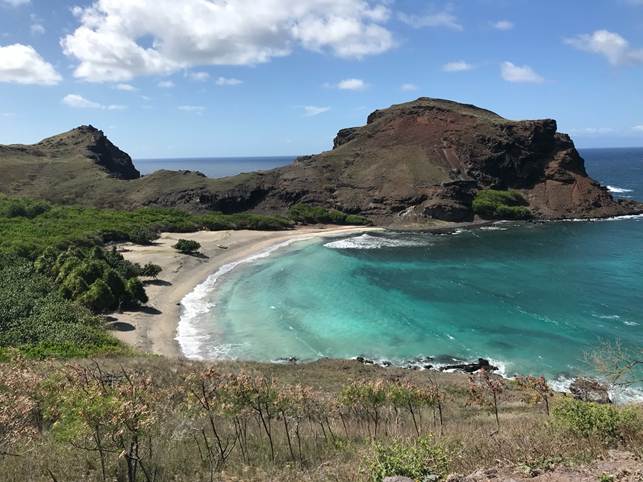 An unexpected beach suddenly appears from the road on Ua Pou island in the Marquesas, French Polynesia (Photo: Emmanuel Toussaint)
Many entomologists travel widely – what was the most enjoyable fieldwork location you’ve worked in, and would you recommend it for a holiday?
I don’t really have a single favorite location in mind but rather within each fieldwork session a particular memory of a very cool place and moment. For instance, I remember in Suriname climbing the Voltzberg during the early hours of the day to watch the sunrise and listen to howler monkeys. I recall sleeping near a river in western Tanzania and hearing the hippos grunting in the water before walking directly by our tents at night sometimes tripping on the guy ropes.
Most recently, we climbed the Piton des Neiges looking for a very interesting endemic tiger beetle and truly experienced the broad altitudinal zonation shift while climbing up, from a wet mid-attitude tropical forest that looked from another time to an arid volcanic and bushy landscape. Nevertheless, I would say that driving through the forests of Ua Pou, a beautiful tiny island of the Marquesas, and after a long day of exploration and collecting, diving in the Pacific Ocean absolutely alone might be one the most unique experiences I have had in the field.
If you could have one superpower, what would it be and why?
It may be heavily job-driven but I would go for speaking any language and being able to read or interact with anyone across the planet, that would be something! In my experience, explaining that you are looking for some good tiger beetle habitat in a language different from the three or four available in your toolkit remains much more challenging that asking for a cool beer.
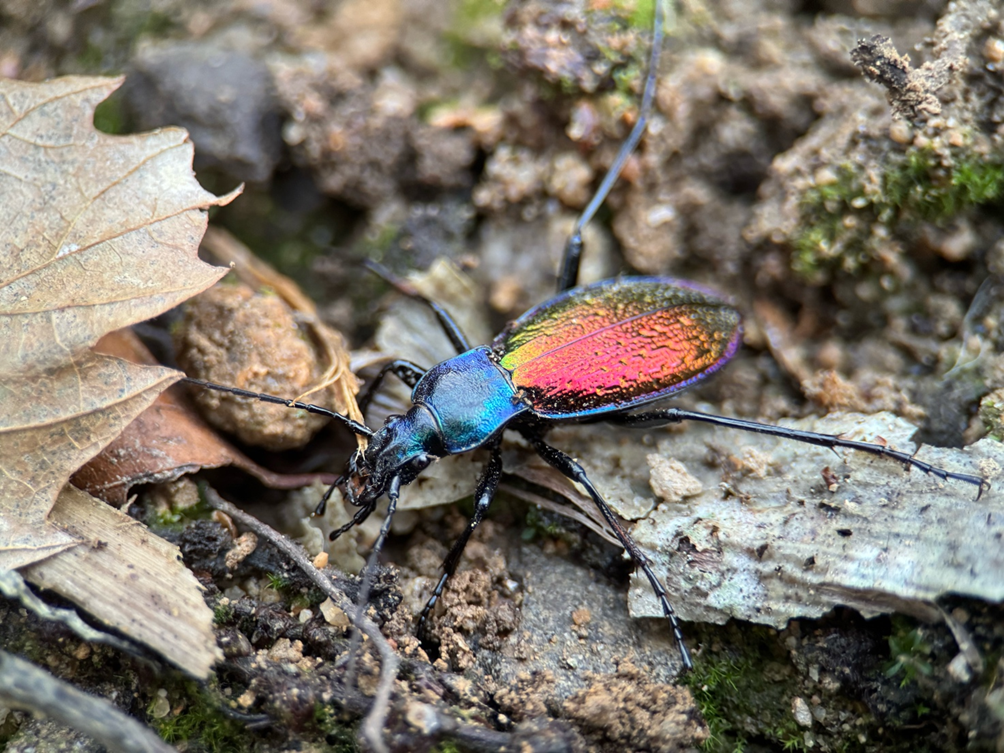 The fantastic Carabus hispanus from Saint-Victor-sur-Loire, France (Photo: Emmanuel Toussaint)
What’s your favourite insect and why?
The species Carabus (Chrysocarabus hispanus) is special to me. It is the only species of this genus endemic to France (unlike what its Latin name suggests, but that’s a long story).
It is also spectacular, almost exotic looking, and lives in places where you will usually encounter nice people as well as superb food and wine. On top of this, it lives among other regions, in one of the most unique places in France, the Forêt de Saou in the Drôme department. I you have not been there, I strongly suggest visiting this spot, a glorious, perched syncline with a luxuriant forest trapped in its heart that makes you feel like you landed on another planet. I have been thinking about doing some small research project on this species and I think the time has come, we even sequenced its genome last year.
What is the best piece of advice you received as an ECR?
Work–life balance in academia is not something you stumble upon, it is something you choose, build, stand by and ideally transmit to your students
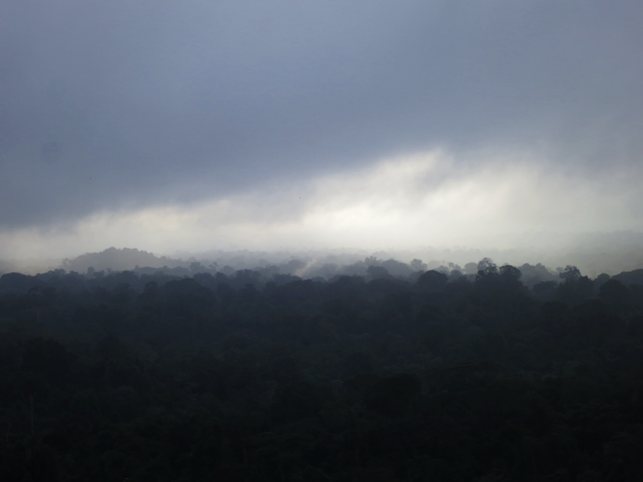 Mystical view on top of the Votzberg in Suriname at dawn (Photo: Andrew Short)
Where are you hoping your research will take you next?
In a geographic sense, I must admit that I am particularly fond of mountainous biotopes, and I have only explored a few across the globe.
The Kilimanjaro, Orizaba and Puncak Jaya are on my bucket list. In a more figurative sense, I am hoping to be able to continue collaborative initiatives and take advantage of the vast array of activities that my position allows (curation, research, teaching, mentoring, fieldwork, outreach, etc.)
If you could wake up with any new skill, what would it be?
The ability to write grants (ideally successful ones) during my sleep would be an amazing time hack!
What motto do you live your life by?
What goes around comes around
Quickfire Questions
Emmanuel’s favourite:
- Place? The French countryside and coastline
- Food? Grilled cuttlefish
- Drink? Natural Wine
- Book? Léon l’Africain / Leo Africanus
- Musician? Chris Stapelton
- Film? The Lives of Others
- Sports team? FC Internazionale Milano
Follow us on social media for updates and share your insect news and events using @royentsoc
