The 9th Society for Vector Ecology International Congress was held in Chania, Crete in 2025 and RES journal, Medical and Veterinary Entomology (MVE) sponsored two prizes in the Early Career Researcher competition.
Editor-in-Chief of MVE, Dr Marion England, attended on behalf of the journal and stood as a judge in the competition alongside Dr Marieta Braks and Dr Eleni Patsoula. It was very challenging for the judges to select winners, but eventually two exceptional scientists were selected.
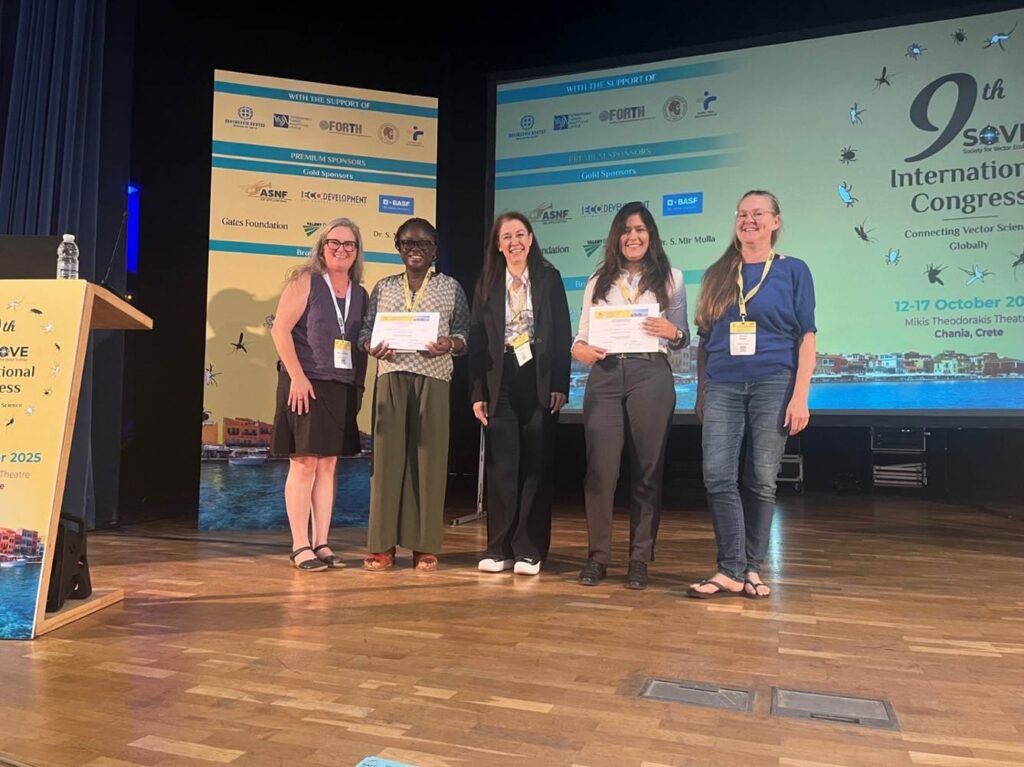 From left to right: Dr. Lyric Bartholomay (SOVE immediate Past-president); Dr. Rosine Z. Wolie (award recipient); Dr. Elina Patsoula (competition judge); Dr. Latifa Remadi (award recipient); Dr. Marieta Braks (competition judge).
Dr Rosine Z. Wolie, from Cote d’Ivoire, won for her oral presentation entitled: “Rethinking malaria, mosquitoes and cities I: Measuring the effects of urbanization on the longevity of malaria vectors in C.te d’Ivoire.”
The poster presentation award was given to Latifa Remadi from Greece for her poster, “Insecticide resistance in sand fly Leishmania vectors in the Mediterranean basin and the Middle East.”
Read on below to find out more about both winners.
Dr. Rosine Zlanneu Wolie is a University Lecturer and Research Scientist specializing in animal genetics, vector biology and vector control. She is a faculty member at Université Nangui Abrogoua in Abidjan and conducts applied research at the Vector Control Product Evaluation Centre based at the Institut Pierre Richet (VCPEC-IPR) in Bouaké, Côte d’Ivoire.
Her work spans malaria vector biology and genomic surveillance, insecticide resistance, mosquito longevity, and the evaluation of next-generation vector control tools in laboratory, semi-field and community settings.
Rosine has coordinated national and international research initiatives, including RAFT Consortium projects, operational studies for malaria control, and evaluations supporting Côte d’Ivoire’s vector-borne disease strategies. Her recent research examines how urbanization and housing structure influence mosquito survival and transmission risk, with the aim of informing evidence-based interventions in rapidly changing environments.
She has contributed to peer-reviewed publications, trained early-career scientists in molecular and entomological methods, and frequently presents her work at international conferences. She is committed to strengthening public health research capacity in West Africa.
Dr Latifa Remadi is a Marie Skłodowska-Curie Postdoctoral Fellow at the Laboratory of Molecular Entomology, Institute of Molecular Biology and Biotechnology (IMBB-FORTH), Greece. She obtained her PhD in Pharmaceutical Sciences at the Faculty of Pharmacy of Monastir, Tunisia, where she conducted her doctoral research in the Laboratory of Medical and Molecular Parasitology-Mycology (LP3M). She has since pursued postdoctoral work in parasitology, entomology, and molecular biology.
Latifa’s current research focuses on understanding the molecular mechanisms of insecticide resistance and transmission competence in sand flies, key vectors of leishmaniasis. By combining field sampling, bioassays, and transcriptomic analyses, she investigates gene expression differences between resistant and susceptible populations. Early findings indicate the upregulation of detoxification genes, including members of the CYP family. Her work aims to improve understanding of vector adaptation and to support the development of more effective and sustainable control strategies in endemic regions.
“It was a pleasure to judge this year’s postdoc competition – The talks and posters were of an exceptionally high standard, reflecting the depth and diversity of research across our community.”
– Marion England, EiC Medical and Veterinary Entomology.
