The 7th Morphology Meeting took place between the 25th and the 28th of February 2026 at the Institute for Zoology and Evolutionary Research, Friedrich Schiller University Jena. The Morphology Meeting is an annual event organized by alternating hosts, in collaboration with the Morphology Section of the German Zoological Society. One of the main goals of this meeting is to support early career scientists by offering a welcoming and friendly environment for presenting ongoing projects, fostering scientific discussions, and building connections.
This year, the Morphology Meeting welcomed over 120 researchers from Germany and neighbouring countries to the meeting.
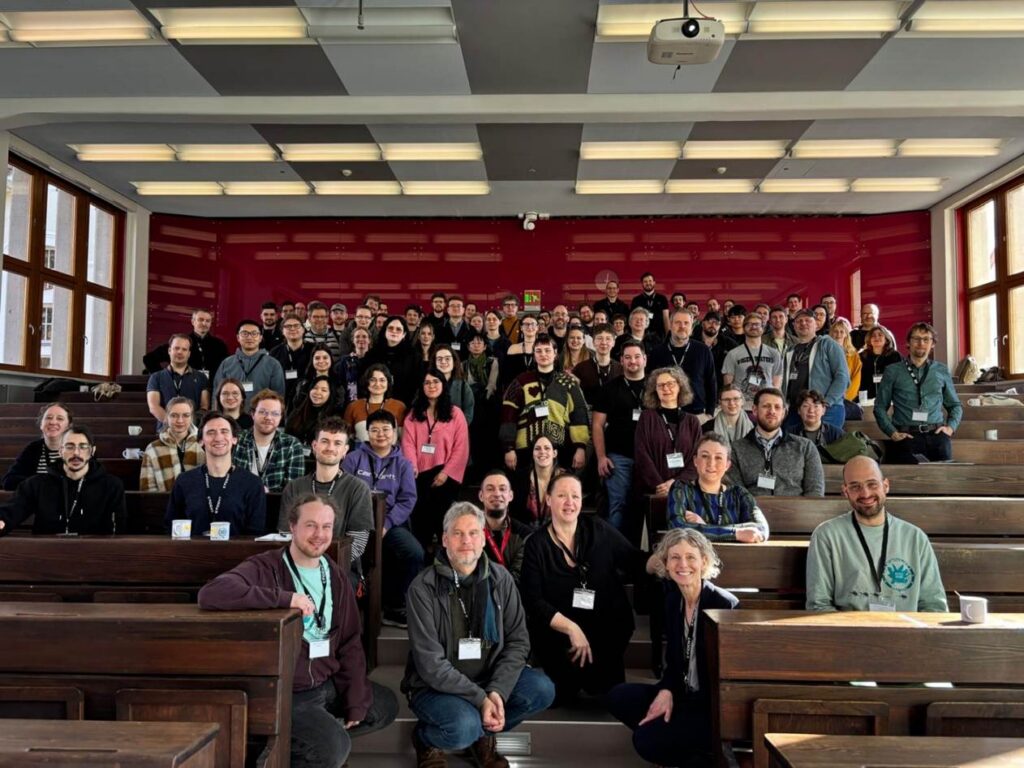 Participants at the 7th Morphology Meeting at the Institute for Zoology and Evolutionary Research, Friedrich Schiller University Jena. Photo credit: Stefan Jerabek
Through financial support from the RES on behalf of Physiological Entomology, they were able to waiver all participation fees, thus promoting the participation of an astounding number of students.
“I believe that supporting early career researchers at conferences and meetings is one of the most meaningful investments we can make in our discipline and this particular conference particularly embraces scientists across all career stages and experience levels. Such events provide opportunities for emerging (as well as established) scientists to share ideas, build networks, and gain confidence in presenting their work.
The curiosity and motivation of people in early career stages is vital for the development of the discipline and contributes to growth and innovation in Entomology.”
– Thies Büscher, Editor-in-Chief Physiological Entomology
There were 39 scientific talks and 14 posters (mostly by students: Bachelors, Masters and PhD). The contributions covered a broad range of integrative research topics such as: functional morphology, taxonomy, phylogeny, experimental biology, biomechanics, development, all with a special focus on morphology.
There were three invited speakers: Tracy Kivell (Max Planck Institute for Evolutionary Anthropology, Leipzig DE), talking about the functional morphology of extant and extinct primates in the light of evolution of hominin dexterity; Yoko Matsumura (Department of Evolutionary Biology, University of Vienna AT) talking about evolution, biomechanics, functional morphology and co-diversification of insect genitalia; and Ben Warren (School of Life Sciences, University of Keele, UK) talked about the functional morphology of insect mechanoreceptors, and the innovative experimental set-ups used for tackling very intricate questions concerning arthropod scolopidia. Additionally, the Keynote Contest was held for the third time this year. This contest is aimed at PhD students and early postdocs, to give them a chance to present their work in a 30-minute Keynote-like slot. The winner was chosen by an external committee by evaluating the abstracts of the contestants (based on originality, depth, potential to inspire). From a total of 11 applications, this year, Paul Kalke (postdoc, Department of Animal Evolution and Biodiversity, University of Göttingen DE) won and presented his work on the evolution of head appendages in bristle worms.
The diverse research topics presented, and the diverse researchers attending enabled a tremendously fruitful exchange of ideas, valuable and extensive discussions, and in general a productive and friendly networking environment throughout the entire conference. As the participants were scientists of all levels, there were beneficial and rewarding collaborations rising between the youngest and the more experiences participants. The Ice Breaker, as well as the poster session and the coffee breaks took place in the Phyletic Museum (right next to the lecture hall where the presentations took place). This allowed participants to further connect and discuss in an environment particularly suited for zoologists.
By choosing to publish, read and review papers in our journals, you are helping the Royal Entomological Society invest in meaningful entomology that supports the understanding, development and future of insect science.
Want to be featured in our Journal Highlights?
Shine a spotlight on your research by submitting your papers to any of our seven journals for the chance to be mentioned on our news pages and social media
