First published: 17 September 2025.
The Royal Entomological Society journal Ecological Entomology has recently published an article on which factors influence the growth of a parasitic fungus on an invasive ladybird.
The researchers highlight that, while the ladybird has spread globally and is threatening local species, very little is known about its natural enemies. In a world where there are more and more invasive alien species, it is important to learn about how the species they interact with can react to environmental factors, especially under climate change.
Ladybirds are some of the most well-known and recognized insects worldwide – everyone loves a ladybird! However, more recently, an invasive ladybird has colonized most of the world: the harlequin ladybird, Harmonia axyridis. Originally meant as pest control against aphids, it was imported to North America and Europe from eastern Asia. There, they established wild populations outside the crops for which they were meant to be biocontrol, and have since spread to every continent except Antarctica. Now, they endanger native ladybird populations by outcompeting and eating them.
The harlequin ladybird has a few natural enemies, like wasps, spiders, mites, and fungi. One of those fungi is Hesperomyces harmoniae, the harlequin beetlehanger, which is a highly specialized strange little parasite that lives on the outside of the ladybird. They form small, green-yellowish, banana-shaped structures that are filled with spores. These spores release whenever the fungi are disturbed, typically when ladybirds touch each other, and then land on the other ladybird, where they attach themselves and mature.
As this transfer often happens when ladybirds mate, you could consider Hesperomyces harmoniae an extremely visible ladybird STD. They also transfer en masse whenever the harlequin ladybirds gather together in winter to hibernate. In spring, some ladybirds can be completely covered in Hesperomyces.
In this study, the researchers looked at how Hesperomyces harmoniae is influenced by temperature and humidity. As the beetlehangers need a living host, they also needed to have a population of harlequin ladybirds to grow them on. To standardize this, all ladybirds looked at were of a known age as they were bred in the lab. Then, a few infected ladybirds were put in a glass tube together with many more uninfected ladybirds, and put in a hot dog roller, which tumbled them (the heating element was taken out, as they did not want roasted ladybirds). This way, they could ensure that the spores were transferred between the ladybirds.
Afterwards, the ladybirds were kept in individual trays in incubators with varying temperatures and degrees of humidity.
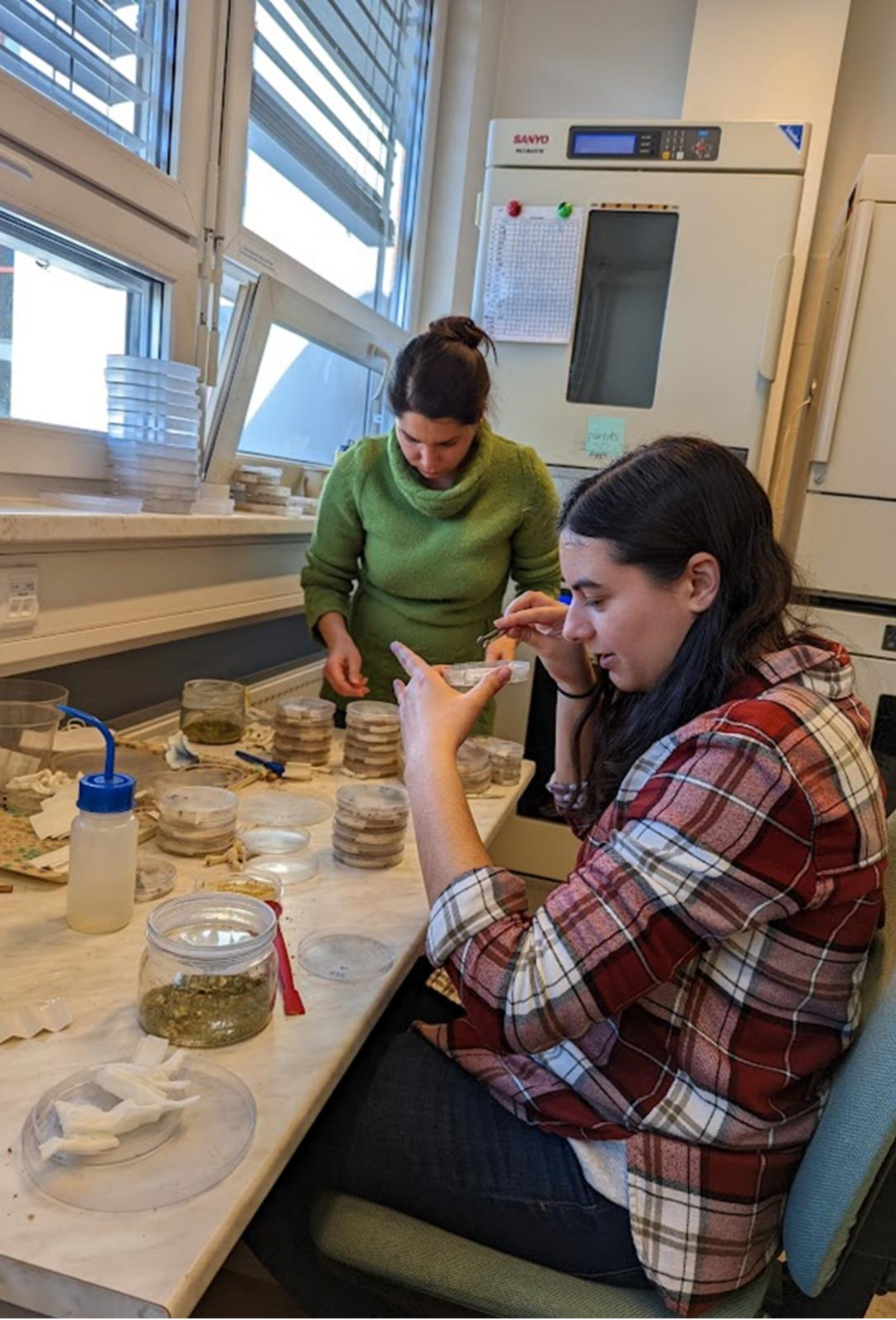 Samaneh Sakaki and Brianna Santamaria
The results are perhaps what you would expect from fungi: they love to grow in high humidity environments, and have an optimal range for the temperature they grow best in (not too hot, not too cold). It also showed that there were no differences between the orange and the black forms of the ladybird or between sexes, and it showed that the fungi particularly grew well on the neck shield of the ladybirds – perhaps because the exoskeleton is thinner there.
 Samaneh Sakaki, Brianna Santamaria, Oldrich Nedved and Michiel de Groot
This research shows that these fungi, which are very understudied, behave quite a bit like “normal” fungi, even though they’re completely dependent on their host.
Understanding how they react to changing humidity and temperature can be crucial to understanding how invasive species and their natural enemies can spread in an ever rapidly changing world.
Want to be featured in our Journal Highlights?
Shine a spotlight on your research by submitting your papers to any of our seven journals for the chance to be mentioned on our news pages and social media
