For over a hundred years the Royal Entomological Society has pioneered the control and conservation of insects, and insect conservation remains an important part of the Society’s 2022-2025 strategic plan, with a priority to support the study and application of insect science.
The Society plays a major role in promoting the science, policy and practice of insect conservation through:
- Its international journal Insect Conservation and Diversity, which focuses on insect (and other arthropods’) conservation and diversity, covering topics ranging from ecological theory to practical management.
- The Society contributes to the Invertebrate Link committee which advises on national policy such as Red data books and codes of practice.
- RES hosts the Conservation Special Insect Group for the dissemination and discussion of results from studies on insect conservation.
- We recognise outstanding contributions to insect conservation – in the UK and overseas – with the annual RES Award for Insect Conservation
- We currently collaborate with four conservation charities – the Somerset Wildlife Trust (SWT) and the Gloucestershire Wildlife Trust (GWT), the National Trust, the J&F Clark Trust – to restore insect and plant diversity to 26 sites of outstanding potential in Somerset and Gloucestershire.
- With the Gloucestershire Wildlife Trust (GWT) we co-own Daneway Banks nature reserve, famed for supporting the second largest population in the UK (and possibly the world) of the Large Blue butterfly, our only species of insect to be listed as a globally ‘Endangered Species’ by the International Union for Conservation of Nature.
Find out more about the data we have collected on the endangered Large Blue Butterfly
Rapid selection for increased dispersal rates by the endangered butterfly Phengaris (Maculinea) arion across restored landscapes
Insect Conservation and Diversity
The LIFE ORCHIDS project
The LIFE ORCHIDS project showcases a comprehensive habitat conservation initiative focused on EU priority dry grassland ecosystems in Denmark, including efforts to restore and connect calcareous grasslands that support orchids, butterflies and other pollinators.
Set within the Natura 2000 network, this project addresses habitat loss and fragmentation by improving habitat structure, increasing species richness and expanding ecological corridors. Activities include converting arable land to flowering grasslands, enhancing management practices and raising awareness among landowners and the public.
Through study tours, workshops and practical tools, LIFE ORCHIDS aims to secure a favourable conservation status for endangered species and their habitats, highlighting the importance of integrated biodiversity conservation action.

The Prince of Wales’s Charitable Fund has supported the Royal Entomological Society by awarding over £200,000 to enable it to create 371 ha of flower-rich grasslands in Somerset and the Cotswold hills of Gloucestershire. The aim is to restore the iconic Large blue butterfly to twelve meadows, totalling 371 ha, alongside a host of other rare, local and more common insects and plants that have largely disappeared from the countryside.
The Society also supported two successful bids made by GWT for Green Recovery and Biffa landfill funding to restore the habitats of rare and common insects to 14 additional inter-linked grassland, wetland and woodland sites along Stroud’s ‘Golden Valley’, with Daneway Banks at its centre. This exciting collaborative project, in one of the richest regions for insects in the UK, began in January 2021.
The Society employs two project officers, David Simcox and Sarah Meredith of Habitat Designs Ltd., who focus on these important projects.
Image: The rare Fly orchid is increasing under new management at the RES-GWT Daneway Banks nature reserve, and exemplifies the complex interactions that can exist between plants and insects. It mimics the specific sex pheromone of the female Digger wasp Argogorys mystaceous, and lures in males which attempt to copulate with it, thereby transferring pollinia from one orchid to the next.
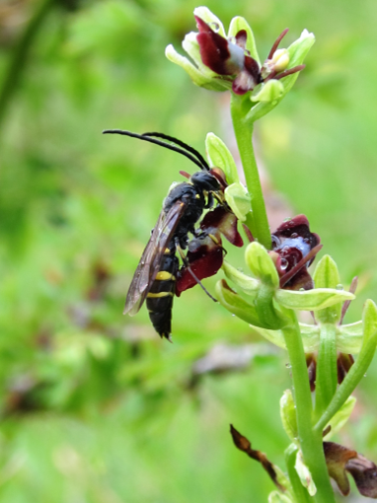 Image Anna Pugh, Daneway Banks, May 2019
