Article by Stuart Reynolds Hon.FRES, Department of Life Sciences and Milner Centre for Evolution, University of Bath
“I’m pickin’ up good vibrations,
She’s giving me excitations…
Good, good, good, good vibrations…”
– The Beach Boys, 1976
Listen to the music: ants
This Research Spotlight is about how ants and other insects detect vibrations in the solid materials beneath their feet, what these vibratory signals mean, and how the insects react to them. As we shall see, interfering with this sensory system may ultimately be useful in ‘green’ pest control. Ants (Formicidae) were the first insects discovered to be insensitive to airborne sounds but nevertheless able to respond to vibrations in the solid substrate. As the twentieth century opened, it was already known (Janet, 1893; Wheeler, 1903) that many ant species produce airborne sounds by scraping one part of the cuticle over another, a behaviour known as ‘stridulation’.
Figure 1. Digging behaviour and stridulation in leaf-cutting ants.
- (a) Workers of Atta vollenweideri carrying soil pellets during nest excavation. Photo: Oliver Geissler.
- (b) Gaster movements (indicated by arrow) produce stridulation signal. Drawing: Malu Obermeyer.
- (c, d) Stridulation organ of an Atta cephalotes worker (note scale bars). SEM images: Flavio Roces.
- (a)-(d) are reproduced (slightly modified) with permission from Sendova-Franks (2012).
- (e) Above: measured acceleration values over time. The calibration bar (acceleration in cm s-2) is valid for both plots. Recordings were filtered below 500 Hz. Below: power spectrum of the signal illustrated above. Reproduced with permission from Pielstrom et al. (2012).
An example of this is shown in Fig. 1; this shows a leaf-cutting ant, but the anatomy and the behaviour are quite similar in many other ants. It had been known since antiquity (Aristotle, 1970) that stridulation is a means of communication between the sexes of grasshoppers, crickets, cicadas, etc. Yet in the opening years of the 20th century, the significance of the stridulatory sounds made by ants was unknown, and since ants do not possess anything that looks like an ear, it was uncertain whether the insects that produced these sounds could even hear them.
In 1903, provoked by this apparent black hole of insect physiology, a Philadelphia medical doctor, Adele M. Fielde, and a Harvard undergraduate (later Professor), George H. Parker, converged on the Marine Biological Laboratory at Woods Hole in Massachusetts, then (as now) far from solely occupied with life in the sea. Fielde and Parker brought with them a collection of musical instruments; they planned to discover whether music with a change in their pattern of movement. This test of the insects’ ability to hear was not in itself a novel idea; the world’s most famous biologist, Charles Darwin himself, had performed similar experiments on earthworms (oligochaetes, not insects!) around 20 years previously.
Typically, Darwin’s experimental plan had been simple, effective and economically described (Darwin, 1881). It involved playing notes from all sorts of musical instruments, including a whistle, a bassoon and a piano, while watching a container of worms. When individual notes were played ‘loudly’ while close to the container in which the worms lived (but not touching it), the worms didn’t move a muscle. But when the same musical instruments were physically connected to the container (i.e., when placed on top of the piano), the worms quickly reacted by twitching. Darwin concluded “Although [worms] are indifferent to undulations in the air audible by us, they are extremely sensitive to vibrations in any solid object”.
Fielde et al. (1907) now extended Darwin’s musical approach to the Formicidae. Eight different species of ant were exposed to sounds and substrate vibrations produced by a piano, a violin and a Galton whistle (a ‘dog whistle’ producing high frequency sounds that cannot be heard by the human ear). The experimenters concluded that, like Darwin’s worms, ants are unable to hear aerial sounds but are exquisitely sensitive to vibrations in the substrate (Fielde et al., 1907). The new study went considerably further than Darwin’s in testing which vibration frequencies are effective. Fielde and Parker found that different ant species reacted to different musical notes; all were very sensitive to very low frequencies, such as the lowest tone on their full-size piano keyboard (bottom A at 27 Hz). The ranges of vibrational frequencies causing a reaction were not only unexpectedly wide but also variable between species; while the top effective frequency in the myrmicine ant, Cremastogaster lineolata, was only one octave above middle C, or 522 Hz, a formicine ant, described by the authors as Lasius umbratus (but which was probably Lasius aphidicola – Schär et al., 2018) was able to detect frequencies three octaves higher, top C at 4176 Hz (Fig. 2).
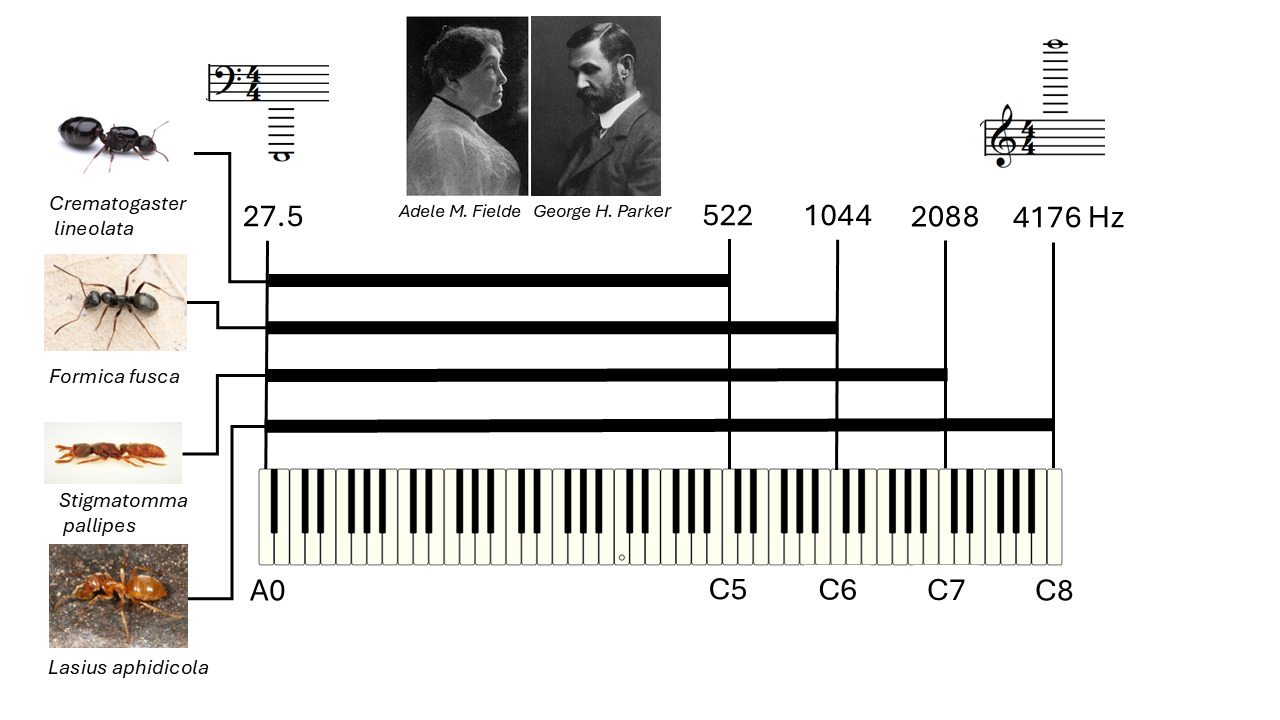
Figure 2. Fielde and Parker’s musical experiment. Various species of ant (just four of those tested are shown here) were tested to determine their reactions to a range of substrate vibration frequencies (designated in Hz).
The substrate vibrations were produced by striking the key of a piano (as shown here) by bowing a violin or blowing a whistle. The ants were contained in an experimental arena that was physically connected to the musical instrument. The range of frequencies that caused a behavioural reaction is shown for each species by a broad black horizontal line. The insects did not react at all to the same sounds if they were not physically connected to the instrument.
- Images: Fielde: public domain image from Stevens, 1918; Parker: public domain image from here;
- Cremastogaster lineolata: image by Conor Cashman, CC BY;
- Formica fusca: image by Marie Lou Legrand, CC BY-NC;
- Stigmatomma pallipes: image by Nick Bédard, CC0 1.0 Universal;
- Lasius aphidicola: image by Tom Murray, CC BY-ND-NC
Other ant species had narrower frequency ranges because they were less sensitive to the highest notes. These results were described by Fielde et al. (1907) without the benefit of statistical analysis; in those days the reader just had to take it on trust that sufficient replications of the experiment had been performed!
As far as I can tell, these musical studies constitute the first published evidence that any insect can perceive and react to substrate vibrations. Only later did Eggers (1928) suggest that the subgenual organs of insect legs (a type of chordotonal organ) have the specific function of detecting such substrate vibrations, an assertion that was experimentally confirmed for locusts by Autrum (1941). Meanwhile, the question of the significance of substrate vibrations in ant behaviour was shelved (Strauβ, 2021).
Good vibrations: social communication in ants
Of course, the realisation that ants can detect substrate vibrations with great sensitivity immediately begs the question of what those vibrational signals ‘mean’. In other words, how does the insect benefit in fitness terms from being able to ‘hear’ them? Are the vibrations that are of interest to the ants produced by their own species, or other insects? Or do the ants benefit by detecting environmental sounds of an entirely different origin?
This supplementary question requires a different sort of experiment. We need to be able to listen in on the insects’ vibrational world – now termed the ‘vibroscape’ (Šturm et al., 2021). This is much less easy than the Darwinian piano-and-bassoon approach, because vibrations in the substrate are localised and carry only tiny quantities of energy. As a result, we humans can’t actually hear what’s going on underneath the insects’ feet with our own ears. But once clever instrumental methods to detect and classify the vibrations have been devised, we can correlate the signals with behavioural reactions. This allows us to ask the
insects themselves what the substrate vibrations ‘mean’ to them – in other words, to reveal their evolutionary adaptive significance.
Although the question of whether ants can detect substrate vibrations is still contested (Hickling et al., 2000; 2001; Roces et al., 2001), most entomologists are now convinced that aerial sounds are at best only a minor component of the ant sensory world. Moreover, although other forms of adaptive significance are not ruled out, it appears that the function of the vibrations is mainly that of intraspecific communication within the colony. Just as Fielde et al. (1907) had speculated, the vibrational signals detected by the ants are produced by the ants themselves.
The vibrations originate from a ‘file-and-scraper’ apparatus very like the Latin American percussive musical instrument called a guiro. Ants from a number of different families possess a stridulatory organ that is found between the petiole and the gaster, where the edge of the petiolar or postpetiolar scraper (the plectrum) is rubbed against a ridged surface (the pars stridens) (Hunt et al., 2013) (Fig. 1). Phylogenetic analysis reveals that such structures are not ancestral within the Formicidae but have evolved on at least five occasions within the family (Golden et al., 2016). Stridulation is extremely common among ants; in the two largest subfamilies, representing the majority of ant diversity, 95% of myrmicine species and 42% of ponerine species possess a stridulatory apparatus.
But this is where the scientific trail of early twentieth century work on ant vibrational communication goes cold. There was no proper follow-up to the prescient speculation of Fielde et al. (1907) about the importance of such signals in ants until the publication of a landmark paper (Markl, 1965) by Hubert Markl of Harvard University. This clearly demonstrated a social communication role in leaf-cutter ants for stridulatory vibrations conducted through the substrate (but not through the air).
Figure 3. Caste-specific vibrational signalling in the ant Crematogaster scutellaris. Panel A: images of Worker and Queen.
Photos by Michael Kukla, CC BY-SA 4.0. Panel B: Examples of oscillograms of substrate-borne vibratory signals during restraining experiments – note that different castes produce signals with distinct characteristics. Panel C: (a) chirp duration, (b) chirp dominant frequency (Hz), and (c) Root Mean Squared (RMS) amplitude of substrate-borne vibrations produced by stridulation. Qfw: queens’ forward chirp; Qbw: queens’ backward chirp; Mfw: males’ forward chirp; Mbw: males’ backward chirp; Wfw: workers’ forward chirp; Wbw: workers’ backward chirp. B and C are slightly modified from Masoni et al. (2021), CC BY 4.0.
We now know that in ants of many species, different types of stridulatory signal are generated according to the ecological and developmental circumstances of the ants that emit them. An almost certainly incomplete catalogue of associations between vibratory signals and behavioural context is given by Golden et al. (2016); ants have been noted to stridulate when excavating a new nest, foraging or retrieving food, feeding each other (trophallaxis) and manipulating brood, as well as during nest emigration and conflict with conspecific colonies. The signaller’s caste may be communicated by vibrational signals, ant queens may stridulate to signal their non-receptivity to males, and worker ants may stridulate when attacked by a predator. Masoni et al. (2021) have shown that several of these behavioural associations are present in a single species, the Acrobat Ant (Crematogaster scutellaris) (Myrmicinae). This ant produces vibratory signals in the frequency range 250–4,000 Hz, which differ in their temporal organisation between castes and when the ants are in the presence of food or are physically restrained (Fig. 3).
“Evolutionary innovations in interspecific interactions often shine a powerful light on the adaptive functions of particular traits within a single species.”
Temporal associations between signals and responses, of course, are insufficient to prove that signalling is selectively advantageous, but evolutionary innovations in interspecific interactions often shine a powerful light on the adaptive functions of particular traits within a single species. In this case, it turns out that the stridulatory signals of a host ant species can be dishonestly mimicked by myrmecophilic mutualists and social parasites to trick the host into accepting them as ‘guests’ in the nest. Larvae and pupae of riodinid and especially lycaenid butterflies, as well as a socially parasitic carabid beetle, Paussus favieri, all of which live in ant nests, emit signals that manipulate host workers to respond to the guests as they do to signals of the host queen, showing significantly higher levels of trophallaxis and guarding behaviour than are elicited by host worker ant calls (Schönrogge et al., 2017). The existence of such deceit is perhaps the surest indication of the adaptive value to the victim of these vibrational signals in honest intraspecific communication.
Not just ants
Even while little or no progress was being made to understand the phenomenon in ants, it was realised that substrate vibrations were important to mate-finding in other insects, especially in the order Hemiptera. A monograph by Ossiannilsson (1949) on the sexual vibratory signals produced by 79 different Swedish species of Auchenorrhyncha (planthoppers) is generally cited as the original source of the modern approach to insect vibrational communication. Ossiannilsson even made old-fashioned phonograph recordings of the ‘sounds’, but other insect sensory physiologists were evidently not yet ready for his suggestion that vibrations in the substrate represented a major new sensory modality in insects. A later paper by Moore (1961), which investigated the vibrational ‘sounds’ produced by 11 species from five families of Hemiptera and 13 species from four families of Auchenorrhyncha and Sternorrhyncha also deserves considerable credit for stimulating further research. Conclusive evidence that, in these insects, communication between the sexes is achieved via substrate vibrations rather than as airborne sound had to wait for technological advances in recording vibrational ‘sounds’.
Eventually, it became possible to monitor substrate vibrations by using a record player cartridge; to make tape recordings of the signals; to analyse them in an oscilloscope; and to replay them to the insects through an amplifier and loudspeaker. Two important papers of this kind (there are others by the same authors) were those by Ichikawa et al. (1974) and Ichikawa (1976); in this work the planthopper Nilaparvata lugens was shown not only to be able to detect conspecific vibrational signals through substrate transmission, but also to respond with appropriate behavioural reactions.
Despite this mid-20th century rediscovery of vibrational signalling in insects, the reaction of the research community remained slow. Even a decade after Ichikawa’s important contribution, the Royal Entomological Society’s 12th Symposium volume Insect Communication (Lewis, 1984) still concentrated overwhelmingly on chemical signals, with only two chapters out of 16 chosen to discuss auditory communication, and coverage of vibrational signals being limited to less than one page of text and just 12 references.
Since then, however, there has been a remarkable turnaround, with a more than exponential rate of increase in publications on insect vibrational signalling. An exhaustive literature search by Turchen et al. (2022) found no fewer than 831 papers on insect vibrational communication. While insects from 17 Orders had been reported to use vibrational signalling for intraspecific communication, the list was dominated by Hemiptera (31.5% of cases), Hymenoptera (21.8%) and Coleoptera (13.5%).
Vibrational sexual signalling in psyllids
There are far too many scientific papers on insect vibratory signalling for me to mention them all, but I should say something about vibrational signalling in the Hemiptera, the insect order that is most strongly represented as communicating in this way. An impressive example is the use of substrate vibrations for sexual signalling in the superfamily Psylloidea.
Both sexes of psyllids have been known since the 1960s to produce ‘buzzing’ sounds, which are characteristic of the emitting species. In early work it was not so easy to characterise these signals. An attempt by Campbell (1964) to characterise psyllid sounds in musical notation (Fig. 4) deserves notice; perhaps this was a direct throwback to the original Darwinian approach. Today, however, it is much easier to record, display and analyse in detail the vibrational signals, and video recordings can be used to correlate the insects’ behaviour with vibrations. While we almost certainly still have much to learn about vibrational signalling in these insects, it is clear that the most important function of psyllid vibrations is in sexual communication.
Figure 4. Vibrational duetting in psyllids. Panel A: An attempt by Campbell (1964) to characterise the vibrational signals of two species of psyllid from New Zealand, Cardiaspina fiscella and C. maniformis, using musical notation. C. fiscella is shown (image by Joseph Knight, CC NC-BY).
Panel B: Macrohomatoma gladiata, male and female adults. Photo by Janis N. Matsunaga, Department of Agriculture, State of Hawaii, USA. Panel C: Vibrational signals in duetting M. gladiata. From Liao et al. (2019). CC BY 4.0.”
Adult male and female psyllids produce distinctive vibrational signals, using them to locate each other on their own host plant by ‘duetting’ (Liao et al., 2022). The male signals his presence by emitting a species- and sex-specific signal, which advertises his own presence, and this solicits a reply from an available female that can hear him. The female’s response is to emit a different but also species-specific vibrational signal that encourages the male to seek her out. Just as in music, the stereotyped timing and sequential relationship of the male and female calls defines the nature of the ‘duet’. The vibratory signals are structurally complex, being made up of distinctive patterns of trills and chirps. The temporal structure of the calls within a species is rather constant compared to the more variable detail of vibration frequency and amplitude of the vibrations within these signal components (Fig. 4).
On the other hand, the sheer variety of vibratory signals found within the superfamily is very great. These calls have now been characterised from more than 100 species of psyllid. This is only a tiny fraction of the Psylloidea, a superfamily comprising eight constituent families, with 4,000 species in more than 200 genera worldwide, many of these being serious crop pests. It is evident from what has been done so far, that most if not all species within this superfamily use substrate vibrations as an essential part of their mate-finding behaviour.
The mechanism by which psyllids produce vibratory signals
was until recently unknown, although it was suggested that they might arise from a stridulatory contact between the wings and the abdominal cuticle. Polajnar et al. (2024) have now shown, however, that in the Pear Psyllid (Cacopsylla pyrisuga), the vibrations are not stridulatory but are produced by oscillatory movements of the wings while they are held immobile at their bases. Physical contact of the wings with the underlying body wall appears not to be required. It seems likely that this is also true of other psyllid species. Presumably, the vibration produced by wing movements is transmitted to the rest of the body from the wing bases and only then to the substrate. This, then, is a similar phenomenon to the vibrations used by honey bees and bumble bees engaged in ‘buzz pollination’ (Vallejo-Marin, 2019).
Good vibrations: sexual and social signalling
What are the general principles of vibrational sexual and social signalling? Here are a few examples of recent research in this area. Vibrational signalling may be important in speciation: female mason bees from two geographically separate subspecies (Osmia bicornis rufa and O. bicornis cornigera) prefer to mate with males from their own subspecies, which use the correct vibrational signals during courtship (Conrad et al., 2015; 2019).
Vibrational signalling is often competitive: in the cicadellid Aphrodes makarovi, both males and females participate in vibrational duetting, which assists males to locate females, but the females simply mate with the first male to arrive. When more than one male is present, males may adopt different calling strategies. Some males ‘eavesdrop’ a male–female duet maintained by a rival, exploiting the rival male’s advertisement calls by silently approaching the female. To interfere with an ongoing male–female duet, males may also emit masking signals that overlap part of the female reply, thus delaying the rival’s progress in reaching the female (Kuhelj et al., 2017).
Vibrational signals can be ‘jammed’ by competitors: in the Neotropical Brown Stink Bug (Euschistus heros) on bean plants, females produce substrate vibrations that attract males to search for and approach the calling female. Duetting then leads to mutual emission of the courtship song and mating. These vibratory signals are readily disrupted when signals from ‘rival’ stinkbug species (Chinavia ubica and Chinavia impicticornis) are present in the environment (Dias et al., 2021). The adaptive function of such trans-species interference is not immediately clear but may be an incidental consequence of intraspecific competition for mates.
Substrate vibrations may be integrated with airborne signals: crickets have been famous as the source of airborne sounds for more than 2,000 years, yet it is becoming increasingly evident that the well-known sexual advertisements and courtship signals emitted by males contain both airborne and substrate components, involving simultaneous wing stridulation, body tremulation, and leg drumming. In the House Cricket (Acheta domesticus) the relationship between these components of vibrational signal is complex and changes as the male approaches the female (Stritih-Peljhan et al., 2024).
Vibrational sexual signalling may contribute to speciation. If this is so, then it would be expected that vibrational signals would be evolutionarily labile, and this appears to be the case in the Pacific Field Cricket (Teleogryllus oceanicus), in which foreleg drumming produces sexually related vibrational signals and appears to be evolving rapidly (Wikle et al., 2023). Intraspecific communication using substrate vibrations is not only sexual in nature: vibrations can also be used to generate spatial order with a population.
For example, newly hatched Falcaria bilineata (Lepidoptera: Drepanidae) caterpillars establish solitary leaf-tip territories (∼10 mm wide) from which they exclude conspecifics, advertising their presence by producing multicomponent vibratory signals which increase in frequency when outsiders approach more closely (Matheson et al., 2025).
On the other hand, producing substrate vibrations may also reduce the risk of predation: communally-living caterpillars (Drepana arcuata) use vibration signals to attract conspecifics to retreat from exposed feeding positions to form social gatherings, where they are less vulnerable to predation or parasitisation (Yadav et al., 2017).
Bad vibrations: eavesdropping by predators and parasites
Substrate vibrations are not used only in sexually-related and social intraspecific communication, but also in eavesdropping by predators and parasites, which can ‘tune in’ to vibrations produced by their victims (Virant-Doberlet et al., 2019). For example, pit building antlions Euroleon nostras are sitand-wait predators that use vibrational signals from approaching insects to estimate both the distance and the direction of their prey (Martinez et al., 2023). Some parasitoid wasps locate their insect prey by detecting substrate vibrations produced by the latter (Meyerhofer et al., 1999; Broad et al., 2000).
“Artificially generated substrate vibrations can be used to control insect pests of crops.”
Substrate-transmitted vibrational signals mediate colony defence in many social insects, and it has been suggested that these vibrations deter predators (Masters et al., 1979). Of course, this deterrence may be because the vibrations are directly confusing or damaging to the potential predator, or because they advertise the availability of other defences such as distasteful or poisonous chemicals. Vibrational deterrence appears to be phylogenetically ancient among Blattodea. Sillam-Dussès et al. (2023) investigated 20 species oftermite (Isoptera) as well as thewood roach, Cryptocercus punctulatus, and found that vibratory alarm signals arose at the base of the group, while chemical alarms have evolved independently in several cockroach groups and at least twice in termites. Vibroacoustic alarm signalling patterns are most complex in the relatively recently evolved Neoisoptera, where they are often combined with chemical defences. The ancient origin of vibratory defence signalling implies that the vibrations have at least some directly deterrent effect.
Substrate vibrations may also be used by potential victims to recognise the approach of a predator. This isn’t strictly signalling, but more a case of a vulnerable individual assessing the suitability of its environment. An example is the recognition of the approach of hunting spiders by Meadow Spittlebugs (Philaenus spumarius) (Cercopoidea, Aphrophoridae); replaying a vibrational signal that mimics the predator provokes a ‘freeze’ response by the spittlebug in which movement ceases (Spadavecchia et al., 2025).
Pest control using vibration
The use of vibrational sexual communication among insects leads quickly to the idea that it might be possible to interfere with these signals in order to reduce reproductive success. And indeed, it turns out that artificially generated substrate vibrations can be used to control insect pests of crops through Vibrational Mating Disruption (VMD). This looks like a terrific idea, since the great thing about vibrational signals is that they disappear straight away – no vibrational residues to cause trouble later on!
Moreover, because the vibrational signals are species-specific, such interference could in principle be narrowly targeted. It has been estimated that as many as 195,000 insect species across all orders may be susceptible to such pest suppression techniques (Cocroft et al., 2005), which offers plenty of opportunity to explore such control techniques.
The first reported attempt at this approach was that of Saxena et al. (1980), who yet again resorted to the good old Darwinian musical strategy. They used a harmonium (a portable reed organ) to generate complex aerial sounds with a low fundamental frequency, but also containing higher frequency harmonics, which they played to insects in the laboratory, while male insects were given the opportunity to approach and mate with females. Continuously playing the note G3 (~ 200 Hz) over a period of several minutes decreased the mating success of the Cotton Jassid (Amrasca biguttula) on cotton plants by 90%. Fundamental frequencies in the range 200–300 Hz were most effective for both this insect and also the Brown Planthopper (Nilaparvata lugens) on rice plants, but these treatments were more effective when the note contained higher overtones. To prevent mating over longer periods it was necessary to play these sounds continuously for long periods (up to several hours) at an intensity of 72–76 db (a sound pressure similar to a vacuum cleaner), the collateral noise pollution from which would almost certainly rule this out as a practical method of pest control. Although it’s amusing to learn yet again of the utility of the ‘musical instrument’ approach to experimentation on insect vibrational signalling, I think that it’s unlikely that anyone ever thought that playing live or recorded harmonium music to fields of crops would become commonplace.
Since this pioneering work, however, many refinements have been attempted and, in particular, it has been possible to apply artificially generated vibrational stimuli direct to plants without audible sound. Significant suppression of insect pests on a horticultural crop has been achieved for two different species of whitefly growing on tomatoes in protected environments. Males of the Greenhouse Whitefly (Trialeurodes vaporariorum) transmit vibrational signals to females at 250–375 Hz. In work by Berardo et al. (2022), artificial vibrations were generated by a computer-programmed minishaker attached to a vibroplate that was connected to the compost in which the tomato plants were growing; the shaking frequency distribution emphasised the fundamental frequencies of the insect’s own vibrational signals and was applied continuously over several days to the host plant pots.
Populations of adult and nymphal whiteflies on the shaken tomato plants grew significantly less quickly than controls and at 57 days, the number of whiteflies on the shaken plants was reduced by 30% compared to controls. In a slightly different approach, Sekine et al. (2023) grew tomatoes on a metal frame that transmitted vibrations at 30 Hz and 300 Hz to the plants and any insects that were present on them. 300 Hz was effective in reducing T. vaporariorum population growth, while 30 Hz was not. Similarly, Yanagisawa et al. (2024) were able to control another whitefly species, Bemisia tabaci, on tomatoes; in this case, the vibrational signals were applied as 1 min of pulsed stimulation every 30 min.
During the 1 min ‘on’, the 100 Hz vibratory signal was applied in a cycle of 1 s ‘on’ and 9 s ‘off’, following an interval of 29 min. This pattern, which had been devised specifically to avoid habituation to the applied signal, was highly effective, reducing B. tabaci nymphs by 40%. unknowns’ in relation to the development of effective vibrational pest control; these include:
- the extent to which the vibrational spectrum of the artificially applied vibrational noise must be tuned to match the insects’ own vibrational signals (e.g., Janža et al., 2024);
- how often and for how long the vibrational signal should be applied (Polajnar et al., 2016; Yanagisawa et al., 2024);
- whether the artificial vibrations that are applied to the crop should be based on male or female mating signals (or both) (Dias et al., 2021);
- the prospects for combining vibrational pest suppressing treatments with other non-insecticidal methods of control e.g., semiochemical disruption (Zapponi et al., 2022);
- the best methods of delivering vibrational signals to pest insects under field conditions, including combining sticky traps with vibrational signals (e.g., Jocson et al., 2025);
- and the extent to which applied vibrational noise may exacerbate spatial dispersal of pests within the crop (Zaffaroni-Caorsi et al., 2022).
Can vibrational techniques achieve effective pest management in the field? The question has been recently considered by Virant-Doberlet et al. (2023) and Yanagisawa et al. (2024). There are encouraging results in controlling the American Grapevine Leafhopper (Scaphoideus titanus) on outdoor grapes (Polajnar et al., 2016), and other applications are being actively considered for vineyards (Thiery et al., 2023). My own judgment is that there’s probably a long way to go before vibrational pest control becomes common. Its high specificity means that there will be high R&D costs in developing it, and it’s also likely to be expensive to deploy; this suggests it is likely to be used only on high value crops, perhaps especially those grown under protected conditions. But since the approach entirely avoids the use of toxic chemicals, it’s worthwhile to explore its potential. Watch this space!
Acknowledgement
I’d like to thank Dominic Gerrard for advice about musical matters.
Professor Stuart Reynolds is a past President and Honorary Fellow of the Royal Entomological Society.
He is Emeritus Professor of Biology at the Department of Life Sciences and Milner Centre for Evolution, University of Bath, and writes regular Research Spotlights for Antenna.

Thank You for 50 Years
Reaching 50 years is a testament to the enduring value of Antenna and the strength of the RES community. Thank you to everyone who has contributed, subscribed, shared photography, written, illustrated or championed the magazine over the decades, and to you, our Members and Fellows, for continuing to support insect science and communication.
Antenna remains a unique space where science meets storytelling – and we’re excited to share the next chapter with you.
Are you a RES Member or Fellow?
Log in to your membership account to request a hard copy of future volumes of Antenna, gain access to significant discounts on handbooks and registration to RES events, and many more exclusive benefits.
Not a Member or Fellow?
