The RES provides free-to-read sample articles for each new issue of our membership-exclusive Antenna magazine, available for you to access wherever you are, from the comfort of your device of choice.
Counting by the billion: weather radar entomology unlocks national scale monitoring of aerial insect abundance
Readers of Antenna will no doubt be familiar with worrying reports of insect declines across taxa (Hallmann et al., 2020). Yet despite claims of a recent and widespread ‘Insect Armageddon’, population collapses are by no means seen everywhere. Among the longest-running monitoring sites, some report declines (e.g., Hallmann et al., 2020), while others see little change (Bell et al., 2020) and some even observe increases (Macgregor et al., 2019). While the drivers of insect declines appear to be severe and expanding (Miličić et al., 2021), the overall picture of the change in insect abundance remains decidedly fuzzy, not least due to a lack of standardised monitoring protocols for many species across much of the world (Cooke et al., 2025).
Standardised monitoring schemes using typical entomological equipment – while providing an invaluable scientific resource – tend to be limited to a relatively small number of sites and focus on a few charismatic or economically important taxa. What is needed is a monitoring technique capable of measuring insects in a standardised fashion over large areas, averaging over local peculiarities to achieve generality. Weather Surveillance Radar networks might provide just such an approach.
In the second half of 2025, a flurry of papers demonstrated the large-scale entomological applications of these weather radars. Mungee et al. (2025) published a 7-year study of spatio-temporal variation in arthropod abundance over the UK, Tielens et al. (2025) provide a 10-year study of insects above the contiguous United States, and Giuntini et al. (2025) investigate the spatial structure of aerial animal migration over a 28-year period. Here, we cover the technical underpinnings of entomological weather radar monitoring, take a closer look at these new results, and suggest an exciting outlook for the future of the field.
Introducing weather radar entomology
Radar (RAdio Detection And Ranging) was initially developed for military applications during and after the Second World War. Later, radar technology was applied to meteorology, used to monitor rain and weather systems. Insects have a central place in the history of radar science – or, perhaps more accurately, insects have a long and proud history of getting in the way of radar observations. In the 1950s, mysterious radar echoes known as ‘dot angels’ were the subject of fierce scientific debate, confusing military and meteorological operators alike. The identity of these angels was not revealed until a three-radar study in the 1960s tracked individual insects using ultra-sensitive radars.
The mystery was solved when it was demonstrated that the ‘angel’ echoes displayed the same electromagnetic scattering properties as flying insects (Glover et al., 1966). To the modern radar meteorologist, insects present a difficult form of clutter that can bias their radar observations. However, insects have also grown into radar targets in their own right, inspiring many different designs of entomological radar. Truck mounted ex-marine radars have been built and deployed for several decades to track desert locust swarms. Another common design is the entomological Vertical Looking Radar (VLR), which uses a narrow, vertically pointing beam.
The VLR can estimate insect mass and orientation up to 2km in the air column directly above the radar, and VLR networks have been used to study insect movement above the UK in conjunction with aerial netting (Hu et al., 2016; Wotton et al., 2019). While specially designed VLRs have long seen entomological applications, weather radars, which scan horizontally (across the landscape) rather than vertically (up into the atmosphere) represent a huge, but largely overlooked, source of ecological information.
Today, over one thousand ground-based weather radar stations around the world are dedicated to meteorological monitoring, covering a much larger area than even the largest entomological VLR networks. Each of these radars emits hundreds of pulses of electromagnetic radiation per second, making several rotations per minute at various angles of tilt, continuously scanning the airspace above our heads; 24 hours a day, 365 days a year. Terabytes of data generated by these radars are used by meteorologists to track and forecast the weather. Luckily, the ‘angels’ noted by early radar engineers never disappeared; disregarded as noise in atmospheric applications, trillions of insects flying above our heads are also detected.
To obtain entomological data from weather radar, we must set off in the opposite direction to our meteorological colleagues. While meteorologists begin by filtering and deleting biological data, radar entomologists do the reverse; filtering out meteorological phenomena and selecting the biological observations. Then, further refinements can be made to isolate insects. Through collaboration between entomologists and atmospheric scientists, we are just beginning to look inside this treasure-trove of ecological information.
How do radars see insects?
To explain how meteorological radars can detect insects, we first must discuss how radar works. A radar wave is an oscillating electromagnetic field moving through space. To any charged or polarisable particle encountered by the wave, the electromagnetic field is experienced as a force pulling the particle back and forth at the frequency of the radar wave.
As the charged particle performs a constrained oscillation under the influence of this force, it will re-emit electromagnetic radiation at the same frequency. This re-emitted radiation is then detected by the radar, allowing the position of the targets to be determined. Dual-polarisation radars are the most technologically advanced operational weather radars, providing the best indication of the size, shape and variety of targets they detect. A polarised radar beam transmits radiation that oscillates only in one direction. Compare a wave on the sea to a telephone wire oscillating in the wind; the sea is constrained to oscillate in only the vertical direction, whereas the telephone wire can move in any direction. Here, the water wave is vertically polarised, and the telephone wire is unpolarised.
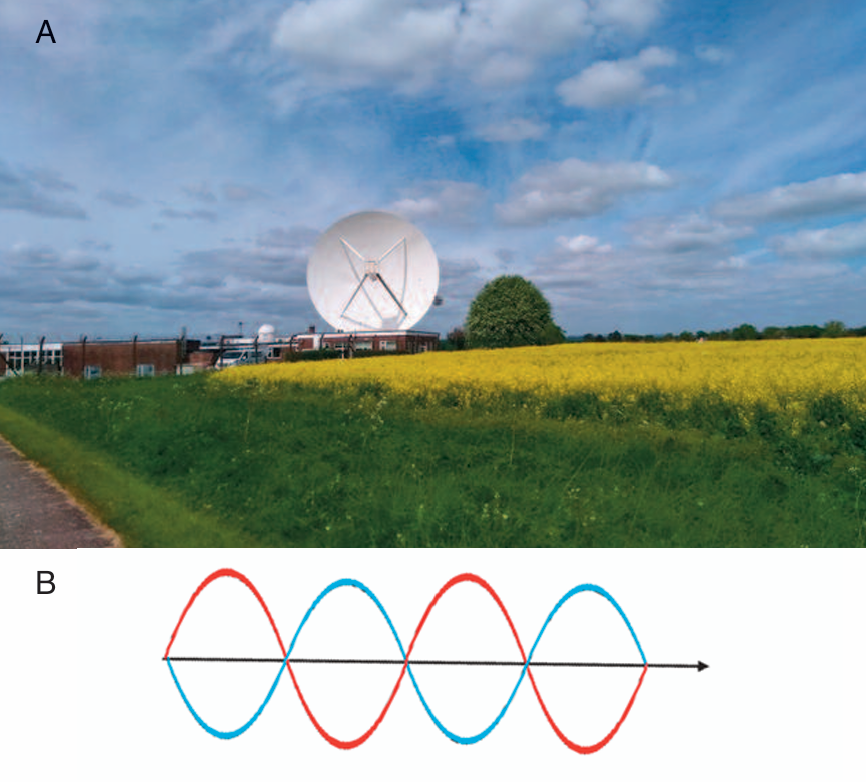 Figure 1. (A) A dual-polarisation radar at Chilbolton Observatory in the United
Kingdom. Credit: F. Addison.
(B) Illustration of a dual-polarisation pulse. The blue wave represents a horizontally polarised wave, the red wave represents a vertically
polarised wave.
Images from Addison et al., 2022; Matthews et al., 2025.
A dual-polarisation radar transmits two beams, one that is horizontally polarised and one that is vertically polarised. The horizontal and vertical components of the return signal are then recorded (Fig. 1).
When an airborne organism such as an insect encounters a radar pulse, polar molecules (primarily water) in its body will oscillate.
The oscillating molecules will then re-emit radiation, the power of which will depend on the extent of the scatter in the plane of polarisation. An animal with a long body, flying horizontally, will scatter more horizontal radiation than a short animal flying horizontally.
If the same organism flies with a horizontal tilt, the horizontal extent will decrease, and the horizontal power scattered will decrease.
Viewed through the two polarisation channels of a dual polarisation radar, biological scatterers generally present a more highly fluctuating, uncorrelated signal than those characteristic of meteorological phenomena. In comparison to raindrops, animals are less symmetrical, present at lower density, and display more dynamic behaviour through active movement. This means a metric called the depolarisation ratio (Kilambi et al., 2018), which considers the relative power and correlation between the two horizontal and vertical radar channels, can be used to filter out meteorological noise from the biological signal (or, if you are a meteorologist, the opposite).
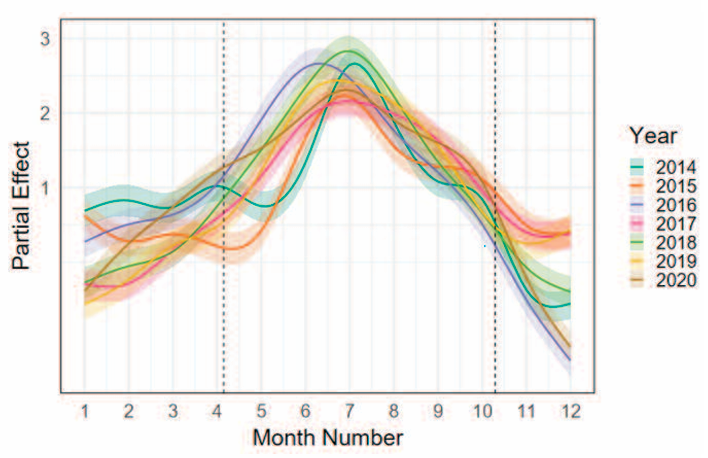 Figure 2. Seasonal variation in maximum daily differential reflectivity at the Chenies weather radar, a dual-polarisation Met Office weather radar in England. Variation in differential reflectivity peaks in summer, matching phenological patterns in insect activity through the year.
Image from O’Connell-Booth, 2025.
Insects tend to have prolate shapes: their long, thin bodies will scatter more power in the horizontal channel than in the vertical channel.
Hence, by comparing the received power in the horizontal and vertical channels of the radar, known as the ‘differential reflectivity’, we can separate signals from insects from those due to other scatters.
As such, Met Office weather radars observe seasonal variation in differential reflectivity, matching phenological patterns seen in insects (Fig. 2).
Recent findings
By applying the filtering procedure described above to Met Office dual-polarisation radars, Mungee et al. (2025) were able to measure the movements of trillions of insects above the United Kingdom. They found that over the period 2014 to 2022, nocturnal insects showed a declining trend, while diurnal counts stayed relatively constant. This finding adds to the mounting evidence that insect declines remain a major concern in the United Kingdom, despite efforts to reduce and reverse damage to natural habitats.
Interestingly, the analysis of Mungee et al. shows a somewhat counterintuitive positive association between urbanisation and the abundance of aerial insects. It is well known that cities (and especially urban gardens) provide a novel, often diverse, kind of ecosystem, driven partly by the wide variety of plants grown in gardens and the relatively warmer temperatures that urban surfaces provide. It appears that these factors may drive higher abundance of insects in the UK, as compared with Britain’s infamously degraded agricultural countryside. This finding is one example of how radar aero-ecological datasets can answer existing questions while generating new hypotheses. In another recent study, using a continental-scale network of dual-polarisation weather radars, Tielens et al. (2025) found that approximately one hundred trillion (1014) insects fly above the United States on a typical summer day.
Analysing over 10 years of archived data, they noted no evidence for continental-scale insect declines between 2012 and 2021. However, looking at more fine-grained patterns revealed high spatial heterogeneity; while 52% of sites experienced increases in insect density, 48% of sites showed declines. They also found that climate change may be having an insidious effect on insect abundance trends — warm winters were associated with fewer observed insects. Interestingly, contrary to Mungee et al. (2025), who found that urban areas compared favourably to farmland in the UK, built-up land in the US was negatively associated with insect abundance. This may be due to differences in the spatial patterning of natural areas between the UK and US.
Weather surveillance radar (WSR) entomology can also be used to address more basic ecological questions. Giuntini et al. (2025) note that while the troposphere constitutes the single biggest habitat on Earth, this portion of global biodiversity is woefully understudied. Using 143 NEXRAD radars, Giuntini et al. (2025) analysed over 108 million 5-minute observations across the United States from 1995 to 2022. Describing diel patterns in insect movement, they found 50% of insect migratory activity was concentrated within a mean vertical band of just 516 metres, beginning at approximately 355 metres above ground level. These migrations were overwhelmingly nocturnal in spring and autumn, with 87.7% and 87.6% of activity respectively occurring at night. Summer showed a much more balanced pattern, with only 54% of activity occurring at night.
Their results highlight the importance of nocturnal migration, suggesting that weather radar data could be used to inform the placement of wind turbines and communication towers to minimally disturb insect flight paths.
Improving WSR entomology
Weather Surveillance Radar entomology currently has a major limitation: the lack of ‘aerial-truth’ data means that one cannot confidently distinguish between insect species or assemblages which are detected by radar. Improving taxonomic resolution is an active area of research, listed by Bauer et al. (2024) as a key target for improving the biological utility of weather radar observations.
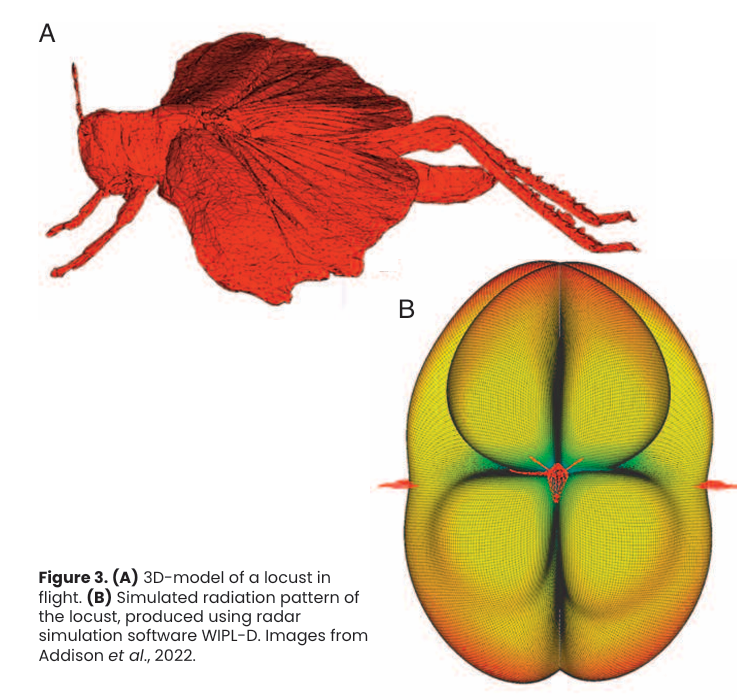 Figure 3. (A) 3D-model of a locust in
flight.
(B) Simulated radiation pattern of the locust, produced using radar
simulation software WIPL-D.
Images from Addison et al., 2022.
One promising line of investigation uses simulation to model the way in which insects scatter electromagnetic radiation back to the radar — their ‘electromagnetic scattering properties’ (Mirkovic et al., 2016; Addison et al., 2022; Drake et al., 2024). Traditionally, due to computational constraints, biological scatterers have been modelled as simple, smooth ellipsoid shapes.
Now, more complex 3D models are used to simulate the key radar-visible features of different insect groups (Fig. 3).
For example, Addison et al. (2022) showed that the scaled wings of Lepidoptera had an impact on the power scattered by the insect, whereas Hymenoptera wings did not.
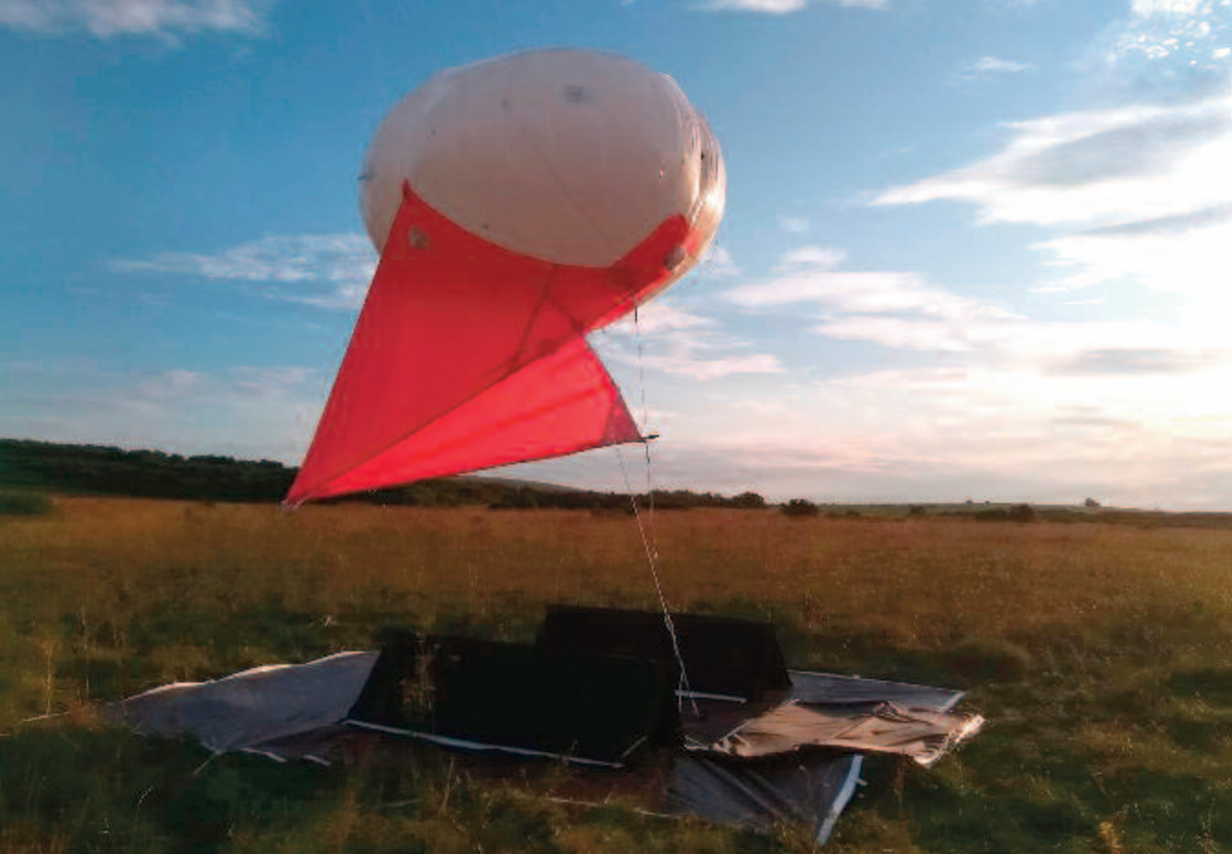 Figure 4. A Helikite, a helium-filled balloon, attached to an entomological net. These kites can be used to sample the aerial insect fauna.
Credit: F. Addison.
Using simulation, coupled with more extensive ‘aerial-truth’ sampling of the atmospheric insect fauna (for example, by aerial netting, Fig. 4; Hu et al., 2016), it is hoped that it may be possible to produce a radar ‘ID guide’, cataloguing the scattering properties of various insect groups (Matthews et al., 2025).
Where dual-polarisation radars are present, WSR entomology may in the future provide a step change in how insects are tracked and monitored.
For example, the UK Biodiversity Indicators, which provide a snapshot describing the state of nature in the UK and how it might be changing, are at present quite incomplete for insects. These are important governmental ‘Official Statistics’ – just like ONS projections play an important role in driving economic policy, the biodiversity indicators should in principle allow the government to assess the progress of nature recovery in the country, evaluate policy action, and assess progress towards meeting international targets.
Yet even the UK insect fauna – perhaps the best surveyed in the world – are underserved by existing biodiversity and abundance indicators, which primarily cover Lepidoptera. Weather surveillance radars, which can measure cross taxa insect abundance across the country at 5-minute intervals, may help to redress these taxonomic biases and provide a more complete picture of insect abundance trends across the UK and the world.
References
Reuben O’Connell-Booth1,
Tommy Matthews2,4, Freya
Addison2,4, Ryan Neely III3,4,
Christopher Hassall2
1 School of Biological Science, Department of Zoology, University of Cambridge, Cambridge, CB2 3EJ, UK; 2School of Biology, Faculty of Biological Sciences, University of Leeds, Leeds, LS2 9JT, UK; 3School of Earth and Environment, Faculty of Environment, University of Leeds, Leeds, LS2 9JT, UK; 4National Centre for Atmospheric Science, University of Leeds, Leeds, LS2 9PH, UK. Christopher Hassall, c.hassall@leeds.ac.uk
References Addison, F.I. et al. (2022) Remote Sensing 14, 1494. Bauer, S. et al. (2024) Philosophical Transactions of the Royal Society B: Biological Sciences 379, 20230113. Bell, J.R. et al. (2020) Insect Conservation and Diversity 13,115–126. Cooke, R. et al. (2025) Science 388, eadq2110. Drake, V. et al. (2024) International Journal of Remote Sensing 45, 2985–3002. Giuntini, S. et al. (2025) Ecology 106, e70247. Glover, K.M. et al. (1966) Science 154, 967 972. Hallmann, C.A. et al. (2020) Insect Conservation and Diversity 13, 127–139. Hu, G. et al. (2016) Science 354, 1584–1587. Kilambi et al. (2018) Journal of Atmospheric and Oceanic Technology 35,1415–1424. Macgregor, C.J. et al. (2019) Nature Ecology & Evolution 3, 1645–1649. Matthews, T. et al. (2025) Ecosphere 16, e70419. Miličić, M. et al. (2021) Conservation Letters 14, e12814. Mirkovic, D. et al. (2016) Scientific Reports 6, 35637. Mungee, M. et al. (2025) Global Change Biology 31, e70425. O’Connell-Booth, R.E. (2025) No effect of Agri-Environment Schemes on radar measured aerial insect abundance at landscape scale in England. MSc by Research thesis. University of Leeds. Available at: https://etheses.whiterose.ac.uk/id/eprint/3 7783/ (Accessed: 25 March 2026). Tielens, E.K. et al. (2025) Global Change Biology 31, e70587. Wotton, K.R. et al. (2019) Current Biology 29, 2167-2173.e5.

Thank You for 50 Years
Reaching 50 years is a testament to the enduring value of Antenna and the strength of the RES community. Thank you to everyone who has contributed, subscribed, shared photography, written, illustrated or championed the magazine over the decades, and to you, our Members and Fellows, for continuing to support insect science and communication.
Antenna remains a unique space where science meets storytelling – and we’re excited to share the next chapter with you.
Antenna Team
Editors: Richard Harrington and Dafydd Lewis. Editorial Coordinator: Jennifer Banfield-Zanin (RES). Associate Editors: Jesamine Bartlett, Benjamin Chanda (PATH, Zambia), Jim Hardie, Louise McNamara (Teagasc, Ireland), Sajidha Mohammed (University of Calicut, India), Moses Musonda (Broadway Secondary School, Zambia), Claire Price (Harper Adams University), Stuart Reynolds (University of Bath), Yanet Sepúlveda De La Rosa (University of Sussex)
All rights reserved. Those wishing to reproduce articles must first contact the Royal Entomological Society. Views and opinions expressed by authors are not necessarily those of the Royal Entomological Society.
Are you a RES Member or Fellow?
Log in to your membership account to request a hard copy of future volumes of Antenna, gain access to significant discounts on handbooks and registration to RES events, and many more exclusive benefits.
Not a Member or Fellow?
Help promote our message
Support doesn’t need to be in the form of a monetary donation – share your support by spreading the word.
