

Insect Hour: The strange sexual biology of stalk-eyed flies
14 October @ 13:00 – 14:00
Insect Hour: The strange sexual biology of stalk-eyed flies
Insect Hour will be held every second Wednesday of the month* from 1pm-2pm (UK time). All are welcome – talks are free to attend and open to both RES members and non-members.
Register to attend below, grab a cuppa or sandwich and join us on Zoom! There will be time for questions and discussion towards the end of the session.
* Excluding August, September, and January
Talk summary
Stalk-eyed flies are very strange looking insects, with eyes held at the end of stalks projecting either side of the head. The group (Diopsidae) has over 100 species, mainly tropical in Southeast Asia and Southern Africa but a few cross-overs into Europe. Many species are sexually dimorphic, with males having elongated eyespan, sometimes greater than body size.
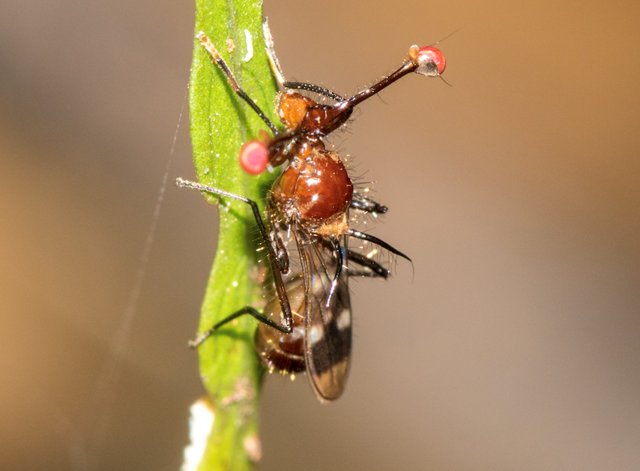
We have been studying Teleopsis dalmanni in which females show strong sexual preference for males with exaggerated eyespan. How do females benefit from their mate choice? Even more interesting, some males carry a selfish genetic element on their X-chromosome (it causes meiotic drive). This disrupts spermatogenesis, killing Y-bearing sperm. Only sperm with the X-chromosome are transmitted to the next generation, so his brood are female only.
How did such a strange X-chromosome arise and why does it persist in natural populations?
Speaker
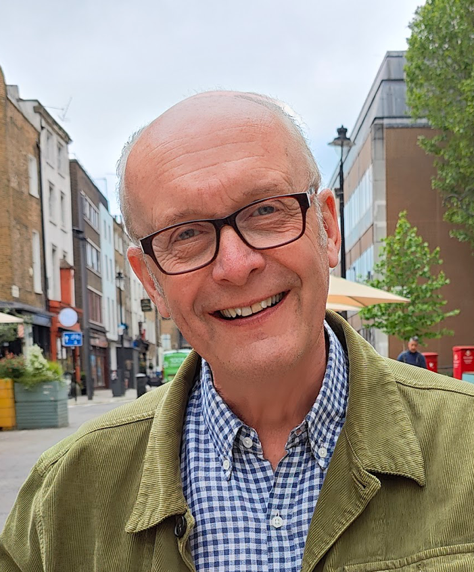
Professor Andrew Pomiankowski, JBS Haldane Professor of Genetics, University College London
Professor Andrew Pomiankowski is J. B. S. Haldane Professor of Genetics and Director of the Division of Biosciences at University College London. He studied Zoology at the University of Oxford, where he graduated with First Class Honours and the Gibbs Prize, before completing a PhD at the University of Sussex under the supervision of John Maynard Smith.
His research focuses on evolutionary biology, genetics and sexual selection, and he has held prestigious fellowships at both Oxford and UCL, including a Royal Society University Research Fellowship. He previously directed the Centre for Mathematics and Physics in the Life Sciences and Experimental Biology (CoMPLEX), promoting interdisciplinary approaches to biological research. Professor Pomiankowski is internationally recognised for his contributions to evolutionary genetics and the study of biodiversity.
Register below by 12:30 (GMT), 14 October 2026
Related Events



Does our work resonate with you? Consider supporting the Society with a donation
Every contribution helps us continue championing insect science, education, outreach and conservation. Like insects themselves, even the smallest actions can have a big impact – so whatever you’re able to give, thank you for helping us inspire curiosity, share knowledge and support a greater understanding of the insects that sustain our world.
Insect Hour is a free online talk series, bringing expert speakers from around the world directly to your screen. We’re proud to make these fascinating talks accessible to everyone, but if you’ve enjoyed an Insect Hour event, please consider making a donation to support our work.