Antenna 50 (1) Highlight – Conservation Science
Article by David Simcox and Sarah Meredith, Royal Entomological Society Conservation Science Team
On 31st March 2025, Sarah Meredith, Jeremy Thomas and I were met by Peer Ravn at Copenhagen airport and driven south in glorious sunshine to the beautiful Møn region where we were to spend the next five days.
Peer, a highly successful and dynamic conservationist (www.ravn-nature.dk), first contacted me in 2019 to ask if we could help prevent the Large Blue butterfly (Phengaris arion) from becoming extinct in Denmark. He explained that although over 50 colonies existed in the 1920s there was now only one small colony surviving on a nature reserve.
Over the following years we helped Peer and his colleagues to apply for funding and in 2024 they were awarded the LIFE Orchids project centred on the restoration and creation of ‘dry grasslands’, crucial to the survival of many of Denmark’s rarest orchids and their one remaining colony of the Large Blue.
Key targets for RES work
Early in 2025, the RES Conservation Science team began working on a four-year contract to carry out research in Denmark with the key aims to:
- Ensure the survival of the existing Large Blue population
- Identify potential nearby sites for future expansion
- Work with site managers to improve habitat quality for Large Blues
- Research, design and implement a reintroduction programme.
Our priorities during 2025 were to carry out baseline surveys to assess the habitat quality of the existing site at Høvblege, these included measuring the distribution and abundance of food plants, host ants and the Large Blue population. This chalk downland site is rich in biodiversity, supports a multi-age mosaic of the Juniper (Juniperus communis) which is declining across Europe, and is regularly grazed by Galloway cattle.
Image: Galloway cattle extensively graze the flower-rich slopes at Høvblege throughout most of the year except during the Large Blue flight period in June and July.
Ant surveys with positive results
We found that Large Blue food plants Thyme (Thymus drucei) and Marjoram (Origanum vulgare) are well distributed across the site in good numbers. We measured the percentage of both plants that lie within the foraging range of the Red Ant (Myrmica sabuleti) which Large Blues parasitise. Small piles of cake were placed next to the foodplants and checked one hour later. The species of ant was recorded, together with the number of ants and the average turf height. Our previous studies have shown that for a site to be able to support a colony of Large Blues this figure must exceed 68% (Thomas et al., 2009). Encouragingly, most of the site surpassed this figure with the large south-facing slopes (F,G,H & I) averaging >90% (Fig. 3).
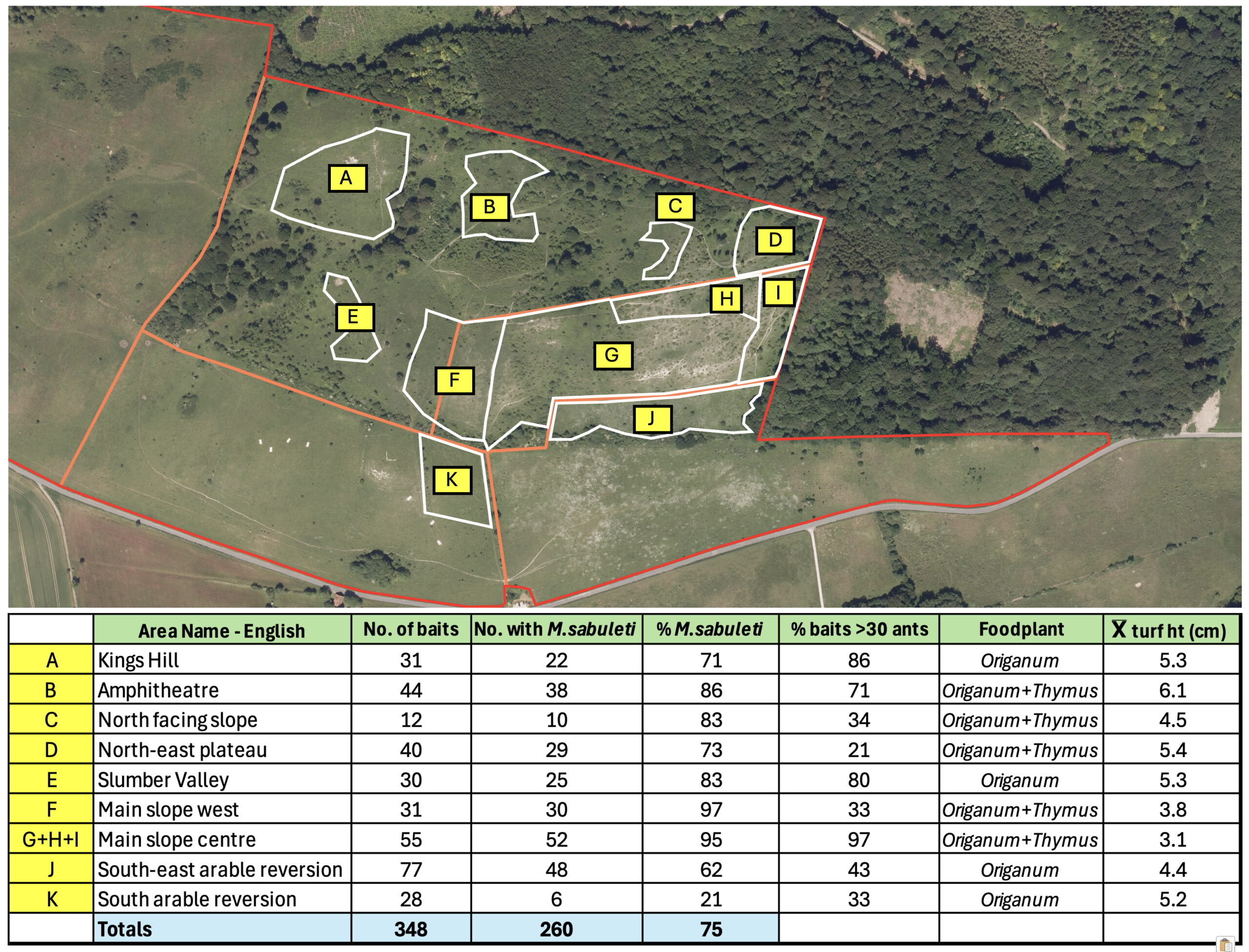 Detailed ant surveys reveal that Høvblege supports robust and numerous colonies of the Red Ant (Myrmica sabuleti) crucial to the survival of Large Blues. The cooler areas C & D will become important in the future under a warming climate.
Measuring the Large Blue population
The first Large Blues emerged on Høvblege on 12th June and by watching egg-laying females we were soon able to confirm that both Thyme and Marjoram were being used. Regular timed counts of adult Large Blues confirmed that they were breeding right across the site and helped us to decide when to carry out egg surveys.
Image: Like most Large Blues on Høvblege, this female has few spots on the upperwings.
The density of eggs laid on Thyme was measured in the field as the eggs are relatively easy to see. However, the dense flowers of Marjoram make this impractical so samples of known numbers of Marjoram spikes were collected and kept in a temporary field laboratory.
Image: Sarah searching for Large Blue eggs laid on Thyme on Høvblege. The pale blue eggs are relatively easy to see in the field.
As the larvae reached their 4th and final instar, they dropped into plastic bowls enabling us to measure the density of larvae per flower spike. The populations of Thyme and Marjoram across the site were measured using quadrats and when combined with their respective egg densities, we were able to calculate that the total Large Blue egg population for the whole site was approximately 166,000 – equivalent to circa 6,500 butterflies emerging over a five-week period.
We have shown that in the UK Large Blue populations can vary by 100-fold (Thomas et al., 2025) and that the Høvblege population in 2025 ranks with some of the largest ever measured.
Image: Sarah searching for Large Blue eggs laid on Thyme on Høvblege. The pale blue eggs are relatively easy to see in the field.
Potential reintroduction sites
In addition to Høvblege, we also carried out detailed surveys on another Danish Nature Agency reserve at the nearby Jydelejet where Large Blues became extinct in the late 1970s – about the same time as in the UK. The results of the surveys were very encouraging with both food plants and M. sabuleti ants being extremely well distributed.
We met regularly with Ditte Gammeltoft and Hele Stuhr who manage these sites and Carsten Horup from Vordingborg Kommune who oversees the whole Life Orchid project. As part of this project, we have been delighted to be able to advise on management issues such as scrub control and grazing to improve the sites’ potential to support Large blues.
Image: Discussing management options with our Danish colleagues, From right: Carsten Horup, Alberte Margrethe Kofoed Larsen, Anna Ravn, David Simcox, Peer Ravn, Ditte Gammeltoft, Markus Raeder Konner, Helle Stuhr and Jens Ljungmann Pedersen.
Plans for 2026
Our key priorities during 2026 will be to undertake detailed ant surveys at both Høvblege and Jydelejet to evaluate the impact of this winter’s management and decide, together with our Danish colleagues, whether to carry out a trial reintroduction to Jydelejet in June and July. During our most recent visit in October we were shown the extensive unimproved calcareous grasslands belonging to the Klintholm Estate which lie between Høvblege and Jydelejet. The Estate is keen to follow our recommendations to increase the grazing which would ultimately enable the Large Blue to naturally colonise, creating a sustainable Large Blue metapopulation as in the UK (Simcox et al., 2025).
This challenging project has enabled us to apply our extensive knowledge of Large Blue ecology to help conserve them in Denmark. To date, we have not noticed any significant differences in the species’ ecological requirements but celebrate seeing it prosper on sites which support such rarities as Wart-biter Bush-crickets, Lady Orchids, Sand Lizards and Juniper.
References
- Simcox, D.J. et al. (2025) Insect Conservation and Diversity 18, 798–809.
- Thomas, J.A. et al. (2009) Science 325, 80–83.
- Thomas, J.A. et al. (2025) Journal of Applied Ecology 62, 1463–1472.

Thank You for 50 Years
Reaching 50 years is a testament to the enduring value of Antenna and the strength of the RES community. Thank you to everyone who has contributed, subscribed, shared photography, written, illustrated or championed the magazine over the decades, and to you, our Members and Fellows, for continuing to support insect science and communication.
Antenna remains a unique space where science meets storytelling – and we’re excited to share the next chapter with you.
Are you a RES Member or Fellow?
Log in to your membership account to request a hard copy of future volumes of Antenna, gain access to significant discounts on handbooks and registration to RES events, and many more exclusive benefits.
Not a Member or Fellow?
