Library and Publications
Article by Rose Pearson, RES Librarian and Archivist
At nearly 2.5m wide and 1.5m high, the oil painting The Aurelians is a striking presence in the RES Council Room at St Albans. Completed in 1909 by South African born portrait painter John Cooke (1866–1932), the painting features two enthusiastic lepidopterist friends, mounting specimens of the British butterflies they were both passionate about. A large entomological display cabinet is prominent in the background.
The two men met as undergraduates at Oxford in 1868, both sharing a love of art and natural history, and went on to have very different careers; on the left is George Blundell Longstaff (1849–1921) and on the right Selwyn Image (1849–1930). Longstaff was born in 1849 to a physician father. His uncle, William Spence, was an economist and entomologist and President of the Society 1847–1848. While studying natural history at Oxford, an accident meant that he lost the sight in one eye, leaving him unable to do microscopic work. This did not stop him travelling to every continent to collect Lepidoptera, as detailed in his 1912 autobiography Butterfly Hunting in Many Lands, which was dedicated “To my old friend and fellow Aurelian, Selwyn Image”.
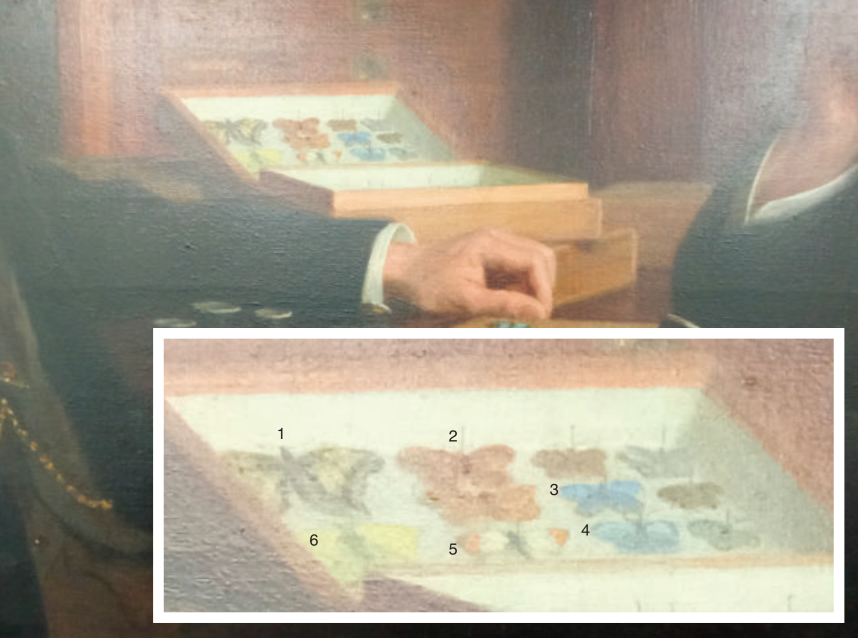 A collection of British butterflies including: Swallowtail (Papilio machaon Britannicus;
inset 1), an unspecified fritillary species (inset 2), Adonis Blue (Polyommatus bellargus;
inset 3), Chalk Hill Blue (Polyommatus coridon; inset 4), Orange tip (Anthocharis
cardamines; inset 5), Brimstone (Gonepteryx rhamni; inset 6) and Holly Blue
(Celastrina argiolus; not numbered).
Credit: Rose Pearson.
Outside of natural history he studied, but never practiced, medicine, wrote on demographics and was elected as the Wandsworth representative for the first London County Council in 1889, serving a total of five three year terms.
He published widely on Lepidoptera, including a note on the Lepidoptera of Wandsworth in the first issue of Entomologist’s Monthly Magazine. Longstaff joined the Society in 1904 and served as Vice President in 1909, 1915 and 1917, published in the Society’s Transactions as well as donating £1,000 (around £55,000 in today’s money) to the Society before his death. He was also a Fellow of the Linnean Society and the Geological Society and a keen supporter of the Hope Department of Entomology in Oxford.
When he passed away after a long illness, Image wrote his obituary in Entomologist’s Monthly Magazine, lamenting: “so passes the oldest and dearest of my friends”. Many Fellows of the Society attended his funeral. Image was born in Sussex, where his father, John, was the local vicar, as well as being one of the original members of the Society. Initially following in his father’s footsteps and becoming ordained as a priest, he began studying art in 1880 and left the clergy two years later.
After studying with A.H. Mackmurdo, who founded the Century Guild of Artists – part of the Arts and Crafts movement – he established workshops for the organisation. He was best known for his work in stained glass, designing windows for around 30 churches. He also designed embroidery, book bindings and furniture. In 1910 he became the Slade Professor of Art at Oxford University and wrote and lectured widely. One of his lectures was reviewed by Oscar Wilde.
He enjoyed regular butterfly collecting trips in London and Essex, as detailed in his collecting notes, which are held in the RES archive, but his favourite collecting area was the New Forest. Image preferred the term Aurelian to Entomologist as he found it more elegant. He joined the Society in 1897, remaining a Fellow for the rest of his life, and served on Council 1909–1911. In 1912, he joined the Entomological Club, the oldest extant entomological society in the world. When the Society moved to new headquarters opposite the Natural History Museum in London in 1921, he wrote a poem to commemorate the occasion. He was also responsible for acquiring portraits of Fellows to be displayed on the wall, including a portrait of the recently deceased Longstaff.
He died in Holloway, London, at the age of 81 and is buried in Highgate Cemetery. In 1932, the painting was donated to the RES by his wife, Janet. It is planned for the painting to remain on display once the RES moves to its new London HQ.
If you would like to view the painting or other items from the RES Collections, please contact the Librarian on 01727 899387 or library@royensoc.co.uk to make an appointment.
Thank you to Sarah Meredith and David Simcox for the butterfly identifications.

Thank You for 50 Years
Reaching 50 years is a testament to the enduring value of Antenna and the strength of the RES community. Thank you to everyone who has contributed, subscribed, shared photography, written, illustrated or championed the magazine over the decades, and to you, our Members and Fellows, for continuing to support insect science and communication.
Antenna remains a unique space where science meets storytelling – and we’re excited to share the next chapter with you.
Are you a RES Member or Fellow?
Log in to your membership account to request a hard copy of future volumes of Antenna, gain access to significant discounts on handbooks and registration to RES events, and many more exclusive benefits.
Not a Member or Fellow?
