Interviewed by Jozsef Vuts (Rothamsted Research)
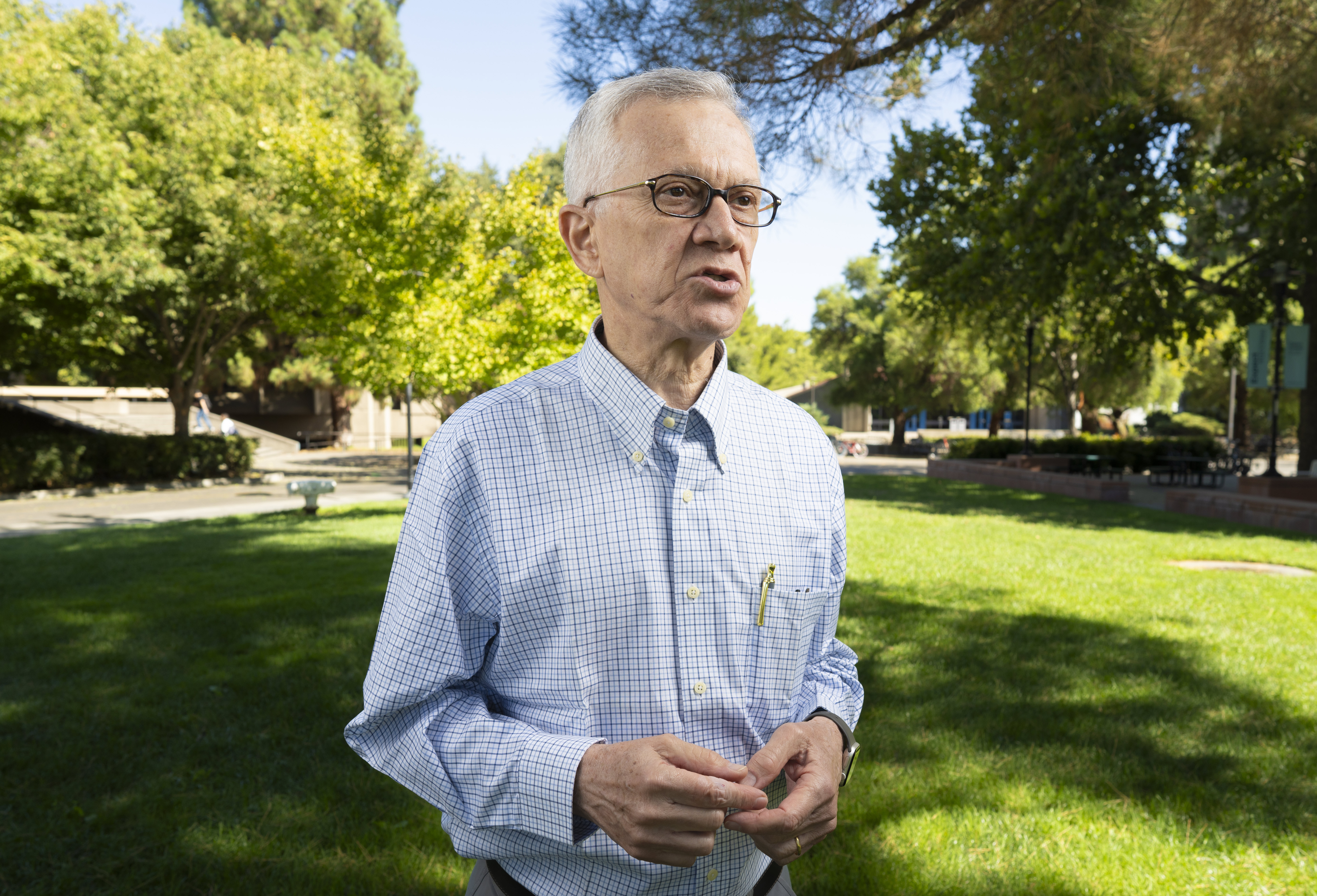 Walter at the UC Davis campus. Credit: TJ Ushing, UC Davis
Walter Leal is Professor of Biochemistry at the University of California Davies.
An iconic and leading figure in insect chemical ecology, his research is unravelling the molecular mechanisms in the olfactory system of moths and mosquitoes, including odorant binding, release and transport, and pH-dependent conformational changes.
Amongst many of his achievements, he was elected to the Brazilian Academy of Sciences in 2012. In that same year, he was awarded a Silver Medal from the International Society of Chemical Ecology, for which he had served as Councillor and President. He became an Honorary Fellow of the Royal Entomological Society in 2015. In 2024, he was elected to the National Academy of Sciences.
Professor Leal served as cochair of the 2016 International Congress of Entomology, a gargantuan gathering of entomologists from all over the globe. I was lucky enough to be there, and it was truly at scale; I had to factor in the journey to get from one symposium to another in time within the same building. (Some participants were state-of-the-art enough to use electric scooters!) Another event with worldwide impact that he invented and organised was the 2021 Insect Olfaction and Taste in 24 Hours Around the Globe, which provided a platform for young scholars to highlight their recent work and interact with well established scholars in the field.
When I logged in at a very late hour, I could see and engage with a lot of bright-eyed, influential people in my own field of chemical ecology – a true ‘Who’s who’ experience. It was thus a great honour to be asked by Richard Harrington to interview a scientist of such a calibre.
How has the field of chemical ecology changed since you started?
It has changed dramatically, because the foundation of chemical ecology was pheromones. People started discovering pheromones through the behaviour of insects and antennal electrophysiology and so forth. And then came the study of plant–insect interactions, later using molecular biology approaches. One issue in the field of chemical ecology is that we are not able to attract many people working with aquatic insects or the aquatic environment in general. Chemical communication in water is quite different and very exciting. We have people from time to time, but that’s not a sector that is following the general trend of chemical ecology. We cannot define chemical ecology today in the same way as it was done before. The definition of the field is the same, but its scope is changing. I love that and want to see people attacking the same subject from different angles.
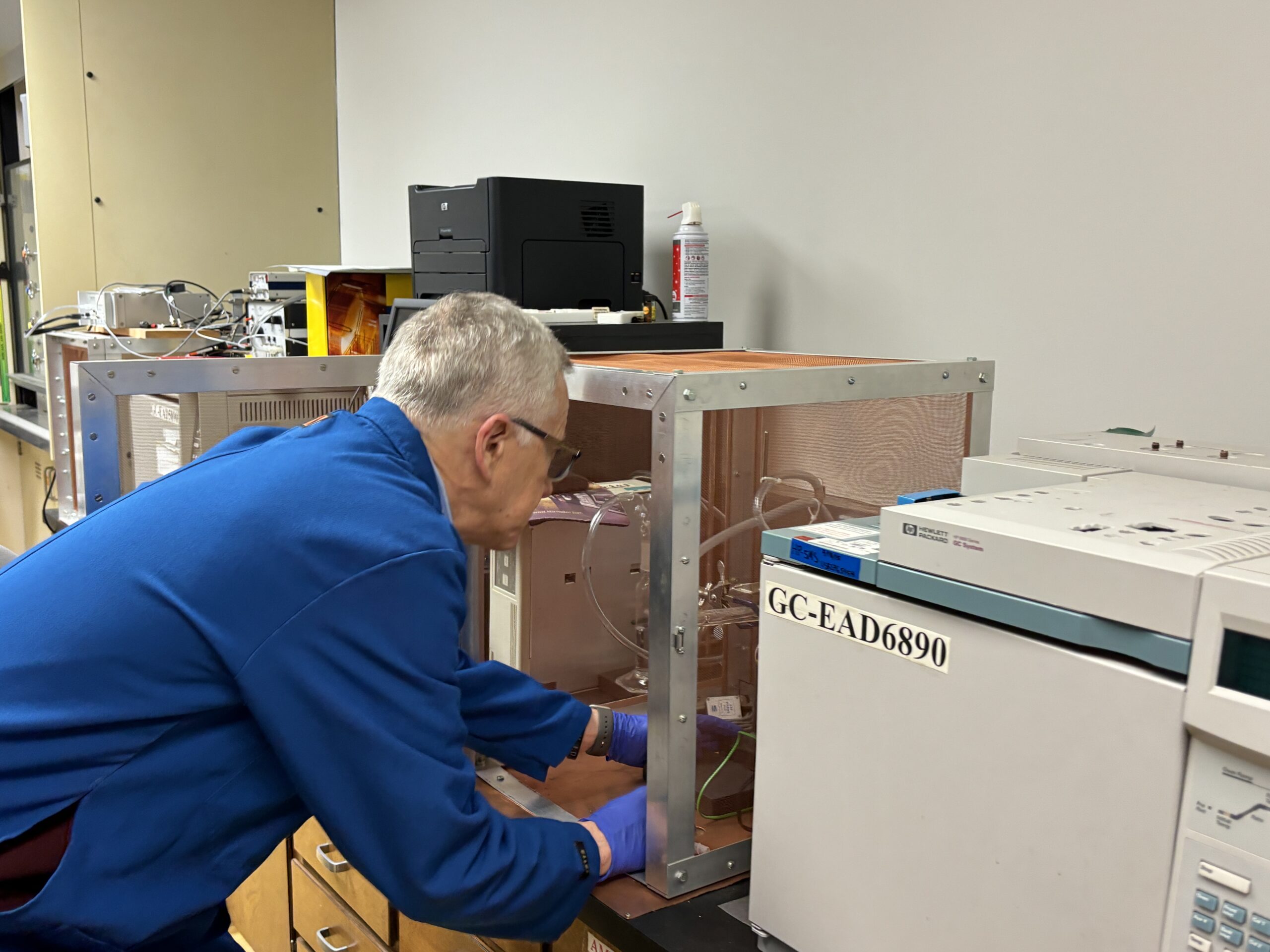 Walter preparing an insect antenna for a GC-EAD analysis. Credit: Sunny Ann, UC Davis; provided courtesy of Walter Leal.
Have new techniques brought new areas into chemical ecology?
Definitely. For example, when we started, we had no idea about genomes and transcriptomes and things like that. These are now standard tools that help answer very important questions. The techniques are very important, but not the goal. For example, many years ago, we discovered a pheromone by just purifying it via behaviour-guided isolation. Then came GC-EAD as a shortcut to guide us and give us the active peak to start the behavioural studies.
Where do you think the best research ideas come from?
Sometimes when we are doing something, we find something else, so we abandon what we were initially doing because it’s not that interesting in comparison. I like that we find something, and we follow the lead. We have to have an open mind and not be too focussed. We don’t always have to have a plan, or we’ll hopefully get something better than the original plan, and at the minimum, the original plan would be covered.
Does our research have to address an important problem, or can it be purely curiosity driven?
I think both. For example, at the moment, I am working with the Asian Citrus Psyllid (Diaphorina citri). So that’s focussed research, because it’s a big problem in citrus cultures, and they want ways and means to reduce populations and, more importantly, reduce transmission of the bacterium that causes the disease. This is applied research. However, some other research can be curiosity-driven, because it allows a deeper understanding of the field. These are two different sectors of chemical ecology, and both are important in the advancement of the field.
Do you think it is justified to divide research into fundamental and applied?
It depends on, for example, where your funding is coming from. If I’m getting money from the growers to do some research, there are expectations that I’m going to have some deliverables for them. It may be that it fails, because research is not a given, it’s an exploratory exercise. So, if it’s for the growers, I say: “OK, maybe I’m going to give you this product at the end”. But if it’s a federal agency, for example, sometimes we have the flexibility to say that this and that would be important to explore, because it might open new directions. An example: a company has just called me to say that they are going to use a pheromone, that I discovered more than three decades ago, for mating disruption. This is not a case of basic research being applied; at that point, it was already applied research. We were looking for a pheromone to monitor the population of this insect, and now, thirty years or more later, a company says, “hey, we’re going to use it for mating disruption, because you have done the preliminary experiments, which worked very well”. It’s very rewarding, because we didn’t plan that. In the meantime, we do many things that are a failure. Like the American chemist Jerrold Meinwald once said: “we’re allowed to make many failures as long as we generate some positive results”.
We all understand that we have failures, and we celebrate the accomplishments, because they are more important. I like thinking of this in terms of vectors: one is positive, and one is negative, but the absolute value of the positive results is much larger than that of the failures. Therefore, the field moves forward. To answer your research that we don’t know of an application for. If we’re looking at the insect brain and mapping the glomeruli to see what they respond to, we may not see the application immediately, but perhaps there is going to be one, or at least we’ll have a better understanding of how biology works.
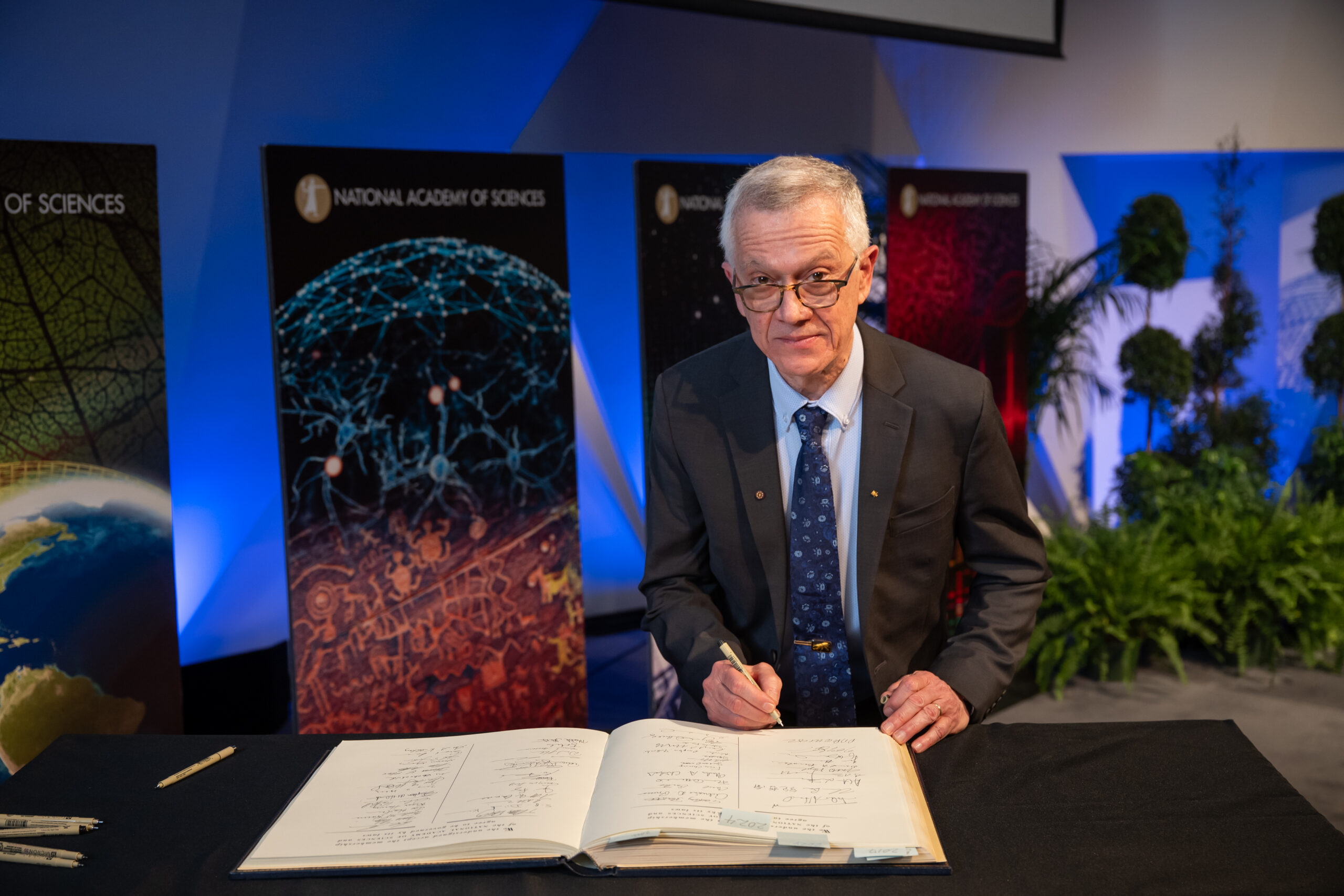 Walter signing the equivalent of the RES’s book of obligation at this Induction at the National
Academy of Sciences (NAS). Credit: NAS; provided courtesy of Walter Leal.
How big a part do you think luck plays in research, as opposed to well thought-through, logical research plans?
I gave a presentation last May about 130 years of my alma mater. I showed various segments of my research, and every single time I ended up saying: “I was lucky, because this thing happened, I was lucky because no one explored that”, and they were making jokes after that about my luck.
But that’s the way of science: we have to be prepared, and we have to have an element of luck. Preparation we can get, but luck comes randomly. A combination of the two is important.
Who were your mentors and what lessons did you learn from them?
There was a teacher at high school who inspired me, Aloisio Sotero. His enthusiasm was contagious, and he brought to me an interest in chemical ecology. I had many mentors, including the professors supervising my master’s and PhD projects. Later, when I spent a sabbatical at Cornell with Jerrold Meinwald for six months, we became friends, and I have learnt so much from him. He had so much influence in my career, and when I had a big decision to make, I would contact him to ask for advice.
If you can single out a paper of yours, which one would that be?
Heavens! That’s one difficult question! There is a paper in the Journal of Chemical Ecology about scarab beetles that Alexander Nikonov, a post doc in my lab, wrote. Nikonov came to the lab, his English was not perfect at that time, so we had problems communicating, and every time I suggested something for Alex to do, he misunderstood me and did something better than I was asking! It was fantastic, because he had great ideas, and he is a brilliant sensory physiologist.
That’s one of the papers I like very much but which didn’t get much attention. In a more recent paper in PNAS, we discovered that mosquito odorant receptors respond to the smell of old, degraded samples, but not to fresh ones. Why? It figures because old samples generate acetaldehyde, which triggers the most sensitive receptor we have ever found in all the species that we have studied. Then we asked the mosquito: “why do you like acetaldehyde?” Well, because it is an oviposition attractant. That paper is also not very well cited; however, it’s a nice story, and the discovery was very exciting. Maybe the field doesn’t yet need this information, but it’s sitting there and will one day be available for researchers going in that direction. On the contrary, the paper where we discovered the receptor for DEET is one of the most highly cited papers.
What do you think the best way is to motivate people about insects or chemical ecology?
Insects are very easy, because people can relate to them. My friend Coby Schal is working with cockroaches, and cockroaches are not very attractive for the general public. But look at the scarab beetles that you and I work with! They are beautiful and it is very easy to show people how interesting they are. Also, if you convey a message about, for example, mosquitos that carry disease, people don’t like mosquitos, but they like to know the story behind them.
For the public, it is interesting that they live part of their life in water and another part outside as terrestrial insects, and only the female sucks blood. In chemical ecology, the easiest thing to talk about is sexual communication, right? Talk about pheromones and say: “you know, these insects don’t see well in the dark and yet the females release this little compound, and the male can find the female using it wherever she is, and they mate”. Or, if you say we can open the brain of the insect and can still record how they sense scents, some people get very fascinated by that, because this is such a tiny thing. If you convey that this information may be useful to understanding humans as well, they like the idea.
What unsolved questions in entomology and chemical ecology do you find most exciting or pressing today?
There is a species of scarab beetle here in California that I have worked on for many years, and I will not retire until I find its pheromone! I know for sure that the compound is there, but in amounts so small that I cannot take a mass spectrum of it. It doesn’t undergo derivatisation, except once by accident, but that’s the only information I know about the structure. I’ve already talked to one of the best chemists in the field, Stephan Schulz in Germany, and showed him what I had, and he even tried with his graduate student to synthesise some molecules to see if their mass spectra matched, but they didn’t. So, to me this is a very important problem, but for everyone else it probably isn’t. People sometimes ask me: “How long does it take to isolate a pheromone?” I tell them that sometimes it takes an afternoon, sometimes thirty years.
In what ways do you think chemical ecology can help halt insect decline?
That’s a difficult question. Chemical ecologists usually get trained to get rid of this or that pest, then all of a sudden, the question comes up about what we can do about declining species. Mattias Larsson in Sweden is doing a good job in identifying pheromones that might be useful in conservation. That’s a completely new area of chemical ecology that I didn’t foresee when I started.
What advice would you give to scientists who are starting their career in entomology or chemical ecology?
It’s vital to look at the literature and know what’s already been done to avoid repetition. When we started, we had to go to the library and look at books, so it was very easy to miss something. Now we have everything at our fingertips. So, spending time first with learning what is already known is a very important thing. If, for example, you study scarab beetles, then we will see that Costelytra zealandica was the first to have its pheromone identified as phenol, then Jim Tumlinson identified the pheromone of the Japanese Beetle (Popillia japonica). We are sometimes required to do a review of the field, which I think is a good idea.
Well, with scarab chemical ecology, one should start with your review. It was certainly the first one for me!
That was the first time that I felt: “OK, now I am an entomologist”, because when the Annual Review of Entomology invites people to write articles for them, you feel like you’ve made it. At that point, it took a long time, because back then again there was no search engine, so I had to figure it out. I wrote that article over several weekends. At the weekends, I only worked on that article, and I thought it was a good review of the field at that point. I am very glad that the Annual Review of Entomology asked me to write a review on olfaction, which became the most cited review paper in the field thirteen years ago. They have asked me to write yet another on insect olfaction, which will come out soon.
Finally: what interests do you have outside of research?
Well, writing papers! It is honestly one of the most rewarding parts of the research, but sometimes the most depressing, because you do your best and the reviewer comes back with a very negative report. However, the process of publishing is very rewarding. You see, now we have to write a story, we have to put it in a package that is going to be very convincing, then we submit it. And one day, it is published, and when it is published, we feel good. I don’t have many hobbies; I spend most of my time working. You see, some people don’t like their job; I love my job so much! Spending a Saturday or Sunday in the lab for me is nothing punitive, I feel good about that. Some people say they like swimming or riding, but I like reading the literature!
I remember when I started my MSc a long time ago, the very first paper that it was compulsory to read was Professor Leal’s seminal review on the chemical ecology of scarab beetles. What made it really enjoyable were stories of my supervisor, Miklós Tóth, who visited Walter’s lab in Japan, where many of the discoveries mentioned in the review were made – stories that transformed scientific research into a relatable, human experience.

Thank You for 50 Years
Reaching 50 years is a testament to the enduring value of Antenna and the strength of the RES community. Thank you to everyone who has contributed, subscribed, shared photography, written, illustrated or championed the magazine over the decades, and to you, our Members and Fellows, for continuing to support insect science and communication.
Antenna remains a unique space where science meets storytelling – and we’re excited to share the next chapter with you.
Are you a RES Member or Fellow?
Log in to your membership account to request a hard copy of future volumes of Antenna, gain access to significant discounts on handbooks and registration to RES events, and many more exclusive benefits.
Not a Member or Fellow?
