
First published: 24 April 2026.
Insects rarely experience predation as a simple matter of being eaten or escaping. Predation risk can generate non-lethal effects that alter larval development, yet how these effects interact with host-plant traits under field conditions remains poorly understood.
In a recent study on monarch butterflies (Danaus plexippus) in Ecological Entomology, researchers tested how predation risk and larval food-plant identity jointly influence larval development and subsequent adult morphology.
Image: Adult male monarch butterfly with narrowleaf milkweed.
Photo Credit: Aramee Diethelm
Using an outdoor common garden experiment, monarch caterpillars were reared on two western milkweeds, Asclepias speciosa and A. fascicularis, with or without predator exclusion. These plant species differ in defensive traits and architectural complexity, allowing the authors to assess how plant traits mediate predator effects across life stages.
Image: Monarch larvae on narrowleaf milkweed.
Photo Credit: Aramee Diethelm
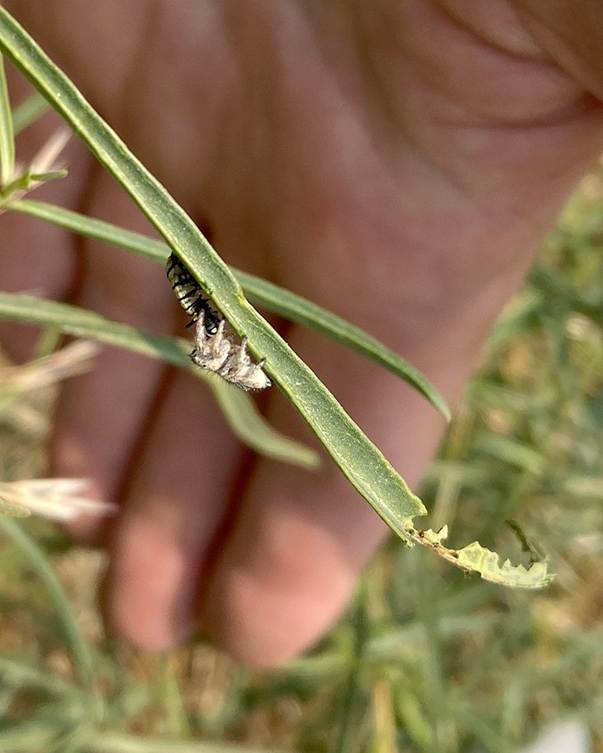
Image: Jumping spider with monarch larvae.
Photo Credit: Aramee Diethelm
The study reveals two key results:
First, predation risk alters larval development in a plant-dependent way. Caterpillars exposed to predators developed more slowly and gained less weight on A. speciosa, but showed little to no response on A. fascicularis. When predators were excluded, performance was similar across both plant species. This indicates that host-plant traits mediate the strength of predator effects, likely by shaping the trade-off between feeding and predator avoidance. Structurally complex plants may provide refuges or reduce predator efficiency, whereas simpler plants may impose stronger constraints on growth under risk.
Second, effects carry over into adulthood. Reduced larval growth was associated with smaller adult wing area, particularly for individuals reared on A. speciosa. This suggests an indirect pathway by which predation risk during development can influence adult morphology, with potential consequences for dispersal and migration.
Image: Monarch larvae with showy milkweed.
Photo Credit: Aramee Diethelm
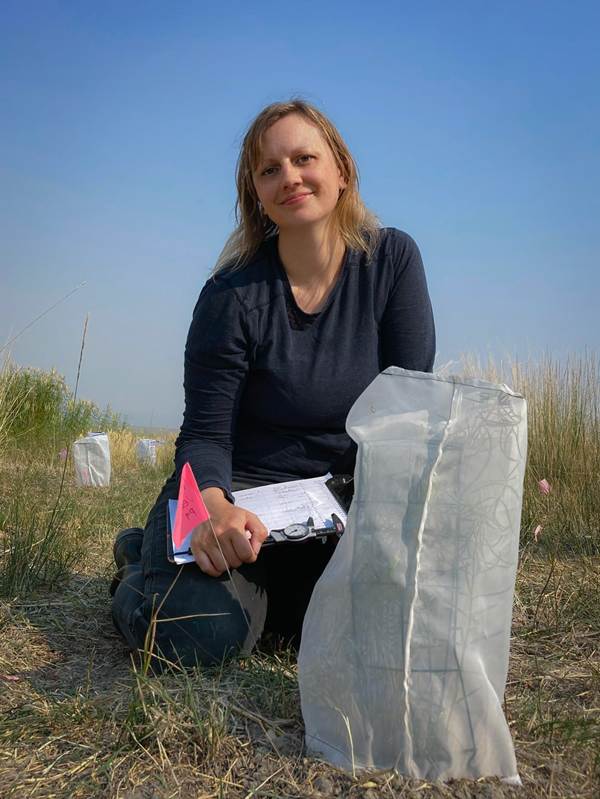 Aramee Diethelm working with the caging setup from the study (in a different field site)
“These results show that predation risk is filtered through host-plant identity, with consequences that can carry from larval growth to adult morphology. Future work is needed to disentangle the plant traits driving these patterns, particularly the relative roles of defensive chemistry and structural complexity, and to incorporate behavioral observations that clarify how caterpillars balance feeding and predator avoidance in natural systems.
The study highlights the complexity of larval development in natural settings and points to the need for further research on how plant traits and predation interact in shaping insect life histories.”
– Dr. Aramee C. Diethelm

Want to be featured in our Journal Highlights?
Shine a spotlight on your research by submitting your papers to any of our seven journals for the chance to be mentioned on our news pages and social media
