Data & bioinformatics Molecular biology & genomics

Published: 30 September 2026.
Vector-borne diseases such as malaria, dengue, and leishmaniasis continue to impose a severe global health burden. Recent advancements have been made in gene drive technology and containment trials of mosquitoes engineered to secrete anti-parasite peptides. However, reliance on freely diffusing, soluble effector payloads present inherent biomedical vulnerabilities. In the gut lumen of insects, soluble antimicrobial peptides face rapid proteolytic degradation, dilution, potential host toxicity and the risk of resistance evolution.
In a commentary published recently in Insect Molecular Biology, The anchor and the architect: Merging gene drive, membrane tethering and generative AI for next-generation vector control, researchers Yanan Wei, Yanying Sun, Jeong Kyu Bang, and Woo Jae Kim propose a novel conceptual blueprint to overcome these limitations: the t-AMP (Tethered Antimicrobial Peptide) platform.
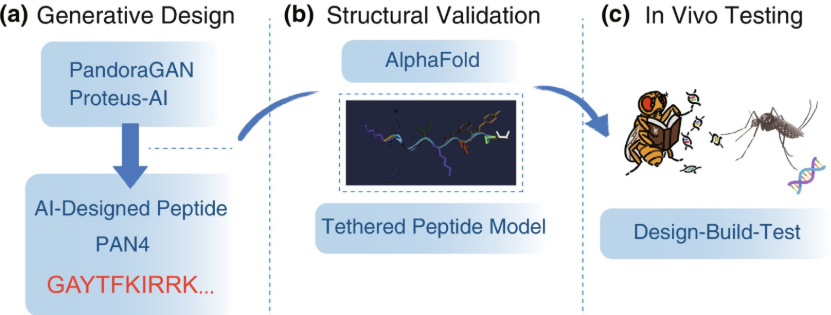 Image 2: Artificial intelligence (AI)-driven design pipeline for tethered peptides. (a) Generative design: Utilization of models like PandoraGAN or Proteus-AI to generate novel peptide sequences (e.g., PAN4) optimized for specific properties (low toxicity, high stability). (b) Structural validation: Use of AlphaFold3 to predict the folding of the peptide when fused to a glycosylphosphatidylinositol (GPI)-linker, ensuring the tether does not disrupt the cysteine-stabilized alpha/beta motif essential for function (as seen in the contrast between t-Def1 and t-Def2). (c) In vivo testing: The ‘Design-Build-Test’ cycle using Drosophila as a high-throughput screening platform before translation to target vectors like Anopheles or Aedes.
By synthesizing three cutting-edge fields – gene drive mechanics, generative artificial intelligence, and precision membrane-tethering – the authors outline a strategy for engineering “smart” biological barriers directly on vector epithelial surfaces. Instead of secreting soluble peptides into the gut lumen, the t-AMP platform uses a glycosylphosphatidylinositol (GPI) anchor to immobilize peptides to apical surface of enterocytes. Empirical study in Drosophila models has improved that membrane tethering can amplify antimicrobial effects by up to 100-fold while preventing off-target cytotoxicity to host tissues.
To supply this platform with optimized effectors, the authors highlight the crucial role of generative AI. Deep learning models (such as APEXGO or GAN architectures) and structural prediction tools (such as AlphaFold) enable the de novo design of custom peptides and rigid linkers tailored for high stability, low toxicity, and precise spatial orientation. When infectious blood meal is ingested, these anchored peptides form a surface restricted layer that selectively lyses invading pathogens before reaching the gut barrier.
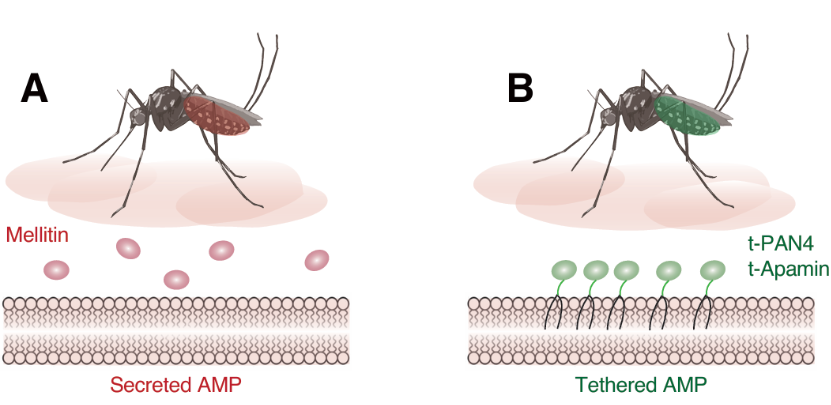 Image 1: Evolution of peptide strategies in vector control: Secreted vs. membrane-tethered peptides in the mosquito midgut (Figure 1 from paper).
“The bottleneck in population-modification gene drives is no longer just the driver itself, but the durability and safety of the effector payload. By shifting from free secretion to surface-anchored, AI-generated peptides, we can construct biological barriers that are significantly more potent and evolutionarily resilient.”
– Yanan Wei, author
While containment trials demonstrate the potential of gene drives, long-term success requires engineering payloads for real-world durability. This commentary highlights technological convergence as a path forward for rational vector design.
Want to be featured in our Journal Highlights?
Shine a spotlight on your research by submitting your papers to any of our seven journals for the chance to be mentioned on our news pages and social media
