PRESS RELEASE 18 August 2026.
How are extreme weather events and climate warming affecting rare grassland species?
The Royal Entomological Society leads landmark research project, funded by Natural England and The Crown Estate, to understand the changing needs of some of our rarest insects and plants to prevent their extinction.
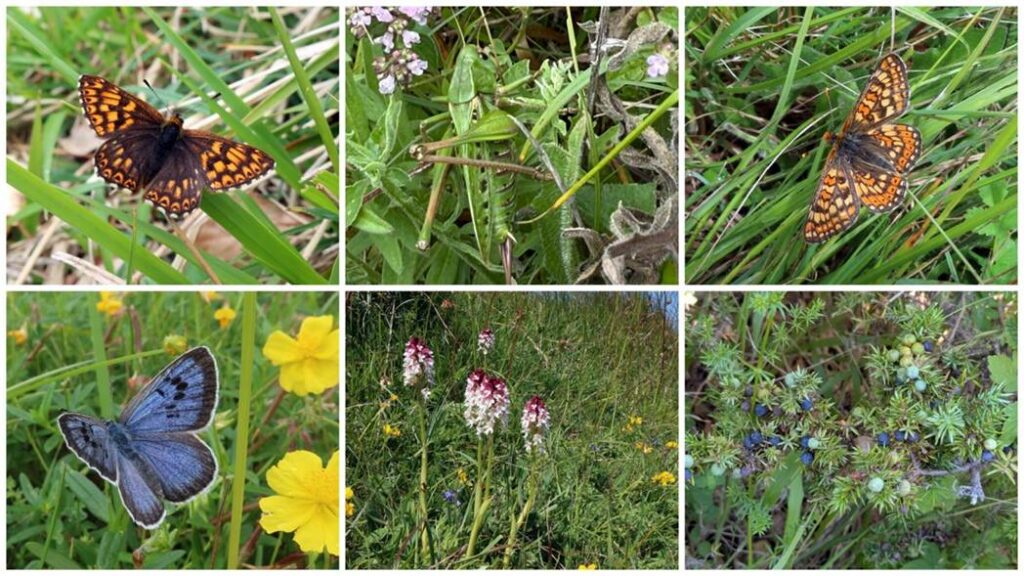 From top left: Duke of Burgundy butterfly; Wart-biter cricket; Marsh fritillary butterfly; Large blue butterfly; Burnt-tip orchid; juniper.
All photos provided by David Simcox, Sarah Meredith and Sophie Mowbray at the Royal Entomological Society
Scientists are investigating whether climate change and increasingly extreme weather are pushing some of England’s rarest insect and plant species closer to extinction.
The Royal Entomological Society (RES) is working with leading environmental organisations to update conservation guidance that is more than 20 years old. Climate change has accelerated dramatically in the time since some current habitat management guidance was written, and urgent adaptations are needed to mitigate the effects of successive heatwaves on plants and the insects that rely on them to thrive.
Working across Somerset, Gloucestershire and Wiltshire, the research project will combine long-term entomological science, new research and practical conservation to help six rare insect and plant species found in lowland chalk grassland – an internationally rare and wildlife-rich habitat – become more resilient to a changing climate and increasingly frequent extremes of weather. The project is one of 130 funded through Natural England’s £60m Species Recovery Programme, as part of the Wild Again: Restoring England’s Wildlife initiative, the largest ever UK government investment in wildlife recovery.
Building on the RES and Gloucestershire Wildlife Trust’s internationally recognised research on the Large blue butterfly (Phengaris arion), which has helped the UK-extinct species recover and thrive, the project will apply the same scientific approach to five other rare species that share these important grassland habitats: the Duke of Burgundy butterfly (Hamearis lucina), Marsh fritillary butterfly (Euphydryas aurinia), Wart-biter cricket (Decticus verrucivorus), Juniper (Juniperus communis) and Burnt-tip orchid (Neotinea ustulate). By looking at these species together, scientists aim to develop practical conservation approaches that will benefit entire landscapes rather than individual species alone.
David Simcox FRES, Conservation Project Manager at the Royal Entomological Society, says:
“As many of us cope with another spell of extreme weather, it’s easy to forget that our wildlife is experiencing exactly the same pressures. Some of the habitat management guidance we still rely on was written over 20 years ago and our understanding, and rate of climate change, has moved on enormously since then.
By combining decades of long-term research with new science, this project will help us understand how six key endangered species are responding to a changing climate and provide practical guidance to support their recovery. Although we are focusing on six species, what we learn will benefit many others that share these habitats, helping to protect and restore biodiversity for the future.”
Combining expertise in research, habitat management and practical conservation to help safeguard some of England’s rarest species, the partnership also includes The National Trust, Gloucestershire Wildlife Trust, Plantlife, Smart Land Management & Ecology and Pewsey Downs Farmers Group.
This landmark project draws on decades of entomological research, combining some of the UK’s longest-running insect datasets with new field research and practical conservation to help us better understand how six ‘at risk’ species are responding to a rapidly changing climate.
The project is one of 130 funded through Natural England’s £60m Species Recovery Programme, as part of Wild Again: Restoring England’s Wildlife, the government’s umbrella campaign to recover our native species and habitats. The Crown Estate will provide additional funding, access and support to the project sites within its ownership.

— ENDS —
For further information and high-res images, please contact press@royensoc.co.uk
Additional partner quotes for media use:
Lisa Edinborough, Restore Nature Delivery Manager at the National Trust, said:
“We will use this research, much of which is happening across many of our grassland sites in Somerset, Gloucestershire and Wiltshire, to update habitat management guidance, giving landowners, reserve managers and landscape custodians – including nature restoration teams at our properties – the evidence and tools they need to build more resilient landscapes and safeguard the species that rely on them for their survival.”
Emma Hutchins from Gloucestershire Wildlife Trust said:
“We are thrilled to be continuing our long-standing partnership with the Royal Entomological Society on this project, building on the ground-breaking conservation work that has helped save the Large blue butterfly from extinction. We are fortunate in Gloucestershire to be home to some of the UK’s rarest species, and to have access to some of its most precious habitat, but we need more information to help us mitigate the effects of climate change and extreme weather events. We hope this research will offer valuable insights and practical solutions to help conservationists across the UK.”
Nicola Hutchinson, CEO of Plantlife said:
“Plants are a vital part of rare and wildlife-rich chalk grasslands, for their biodiversity benefits and the insects that rely on them. There is so much more to learn about the unique symbiotic relationships between these two rare plants, Juniper and Burnt-tip Orchid, and the species that call chalk grasslands home. Amidst a changing climate and more extreme weather, it’s a crucial time to research how these species are coping and how we can support their recovery. We’re thrilled to be part of this project to help conservationists across the country support nature as it learns to cope with extreme weather events.”
Simon Smart from Smart Land Management & Ecology said:
“In order for conservation research and findings to have real-world effects, we need buy-in from land managers and crucially farmers. As climate change and extreme weather place increasing pressure on food production, farmers are recognising that ecological land management can build resilience, reduce reliance on inputs and support sustainable yields. We are excited to be a part of this project, working with Pewsey Downs Farmers Group, to provide the practical application perspective that will be crucial to its long-term success.”
Kirsty Brannan, Biodiversity and Conservation Manager at The Crown Estate, said:
“As part of our commitment to nature recovery, we are proud to support the Royal Entomological Society’s landmark project by providing land in Wiltshire and funding for research that will contribute to a greater understanding of biodiversity and support the conservation of wildlife.”
Notes to editors
About the Royal Entomological Society
The Royal Entomological Society (RES) is devoted to the understanding and development of insect science. The RES supports international collaboration, research and publication, and aims to show every person how remarkable and valuable insects are. https://www.royensoc.co.uk
About the Large blue butterfly
The Large blue butterfly (Phengaris arion) was declared extinct in the UK in 1979 but has since become one of the world’s most successful insect conservation stories. The knowledge and conservation techniques developed through its recovery will help inform the Royal Entomological Society’s Species Recovery Programme project and future conservation work.
Further information about the Royal Entomological Society’s conservation work:
https://www.royensoc.co.uk/about-us/conservation/
About the National Trust
The National Trust is an independent conservation charity founded in 1895 to preserve historic and natural places in England, Wales and Northern Ireland and open them up for everyone to enjoy. Find out more at www.nationaltrust.org.uk
About Gloucestershire Wildlife Trust
Gloucestershire Wildlife Trust (GWT) works closely with local communities, landowners, and partners to deliver much-needed conservation work across more than 1000 hectares of nature reserves, and within the wider landscape of Gloucestershire. This vital work safeguards these remaining special wild places and drives nature’s recovery, working towards a future where the countryside thrives once more with wildlife. The charity also delivers a vast range of engagement activities and projects across the county, as well as providing free public access to its nature reserves, enabling people from all backgrounds to spend time outdoors and get closer to nature. Find out more at www.gloucestershirewildlifetrust.co.uk
About Plantlife
Plantlife is the global charity working to enhance, protect, restore and celebrate the wild plants and fungi that are essential to all life on earth. With two in five plant species at risk of extinction, biodiversity loss is now the fastest it’s ever been and Plantlife’s work has never been more vital. Plantlife champions and accelerates conservation action, working at the heart of a global network of individuals and organisations, to influence and inspire landowners and land managers, public and private bodies, governments and local communities. As time begins to run out, Plantlife’s position as the global voice for wild plants and fungi will help to bring lasting and positive change to our natural world – for everyone’s sake. Find out more at www.plantlife.org.uk
About Smart Land Management & Ecology
Smart Land Management & Ecology (SLME) provides practical, expert support in sustainable land use, habitat management, and environmental conservation. With over 40 years of combined experience, SLME helps farmers and land managers build resilient landscapes and profitable businesses by integrating agricultural and ecological expertise. SLME makes policies, incentives, and environmental markets accessible, supporting projects from planning through to delivery and long-term management, including landscape-scale conservation. Find out more at www.slme.co.uk
About The Crown Estate
The Crown Estate was established by Act of Parliament to create long-term value for the nation. We manage a £17bn portfolio of land and assets across the UK — from Regent Street and St James’s in London’s West End and Windsor Great Park, to one of the country’s largest rural holdings, as well as the seabed and much of the coastline around England, Wales and Northern Ireland.
Our role is to grow this portfolio responsibly and return our profits to HM Treasury for public spending — contributing £5bn over the past decade.
Through our work, we support the UK’s transition to a more sustainable, inclusive and resilient economy. This includes enabling offshore wind and emerging energy sectors, supporting regenerative land use, and investing in places and communities to help them thrive — from central London to rural and coastal communities nationwide.
For further information please contact The Crown Estate Press Office: 0845 241 2342 / pressoffice@thecrownestate.co.uk

Follow us on social media for updates and share your insect news and events using @royentsoc
