
Published: 21 August 2026.
A piece of wood can look completely quiet while, under its surface, an entire termite colony is at work.
Drywood termites can spend months or even years hidden inside wood, tunnelling, feeding and expanding their colonies. By the time an infestation becomes visible, substantial damage may already have been done. But if termites cannot be seen, how can we detect them?
Perhaps by listening.
In a new study published in Approaches in Entomology: Methods, Philosophies and Ethics, “Machine learning-assisted vibrational detection and classification of drywood termite infestations”, Lírio Cosme and colleagues investigated whether the vibrations produced by drywood termites could reveal what is happening inside apparently intact wood.
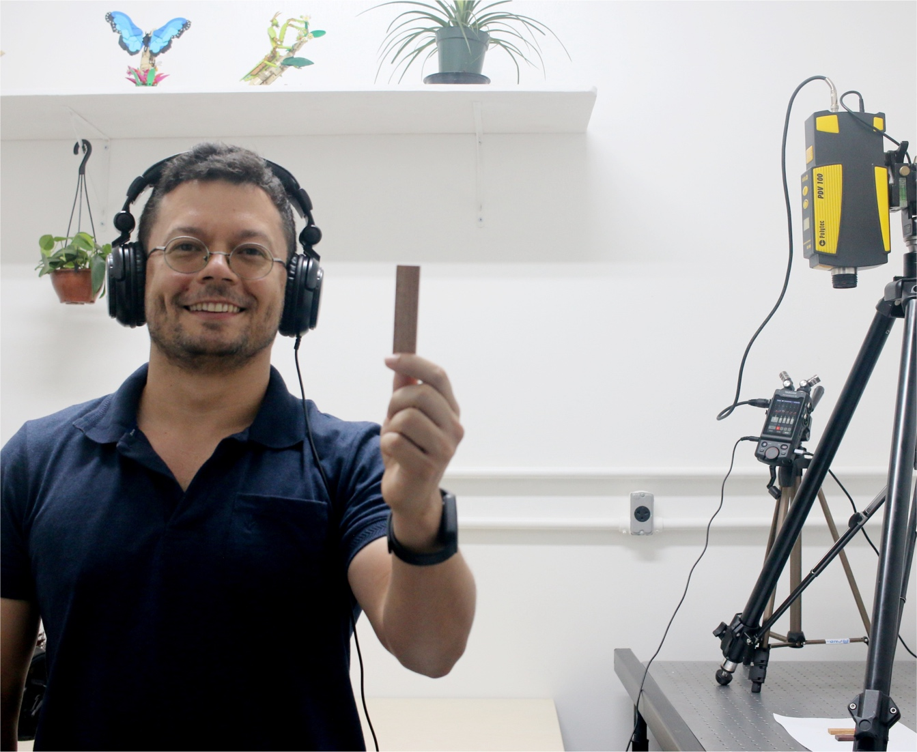 Lírio Cosme presenting a wood piece, with the laser Doppler vibrometer system configured for the acquisition of vibratory cues.
Photo Credit: Leo Turchen
“Termites may be hidden, but they are not completely silent. As they move through wood and feed, they generate low-frequency vibrations that travel through the substrate”
– Lírio Cosme
Although these vibrations are too low for us to hear, they may contain information about termite activity. To investigate this possibility, the researchers prepared wood pieces containing either no termites or different densities of West Indian drywood termites. X-ray imaging was used independently to determine the number of termites inside each piece. The researchers then recorded surface vibrations with a laser Doppler vibrometer, a highly sensitive, non-contact instrument capable of measuring minute movements of the wood.
 Lirio Cosme presenting a radiograph of a wood piece, showing the internal tunnel networks and termite pseudergates.
Photo Credit: Leo Turchen
The recordings were converted into quantitative features and analyzed using eight machine-learning algorithms. The models were trained to distinguish termite-free wood from infested wood and, more ambitiously, to differentiate among infestation levels. An independent dataset was then used to test their performance.
The results revealed a detectable vibrational fingerprint of termite activity. Machine-learning models successfully distinguished infested from termite-free wood and could further differentiate empty wood from pieces containing fewer than 10 termites or more than that. The best-performing models achieved up to 93% accuracy during internal validation and 95% accuracy with independent data.
“In other words, termite activity left a detectable vibrational fingerprint, and the machine learning algorithms can learn how to recognise it,” says Lírio Cosme.
The findings point to a promising new approach for detecting insects hidden from view. In the future, vibrational sensing technologies could potentially help monitor termite activity in wooden structures, furniture, or other valuable objects without opening or damaging them, and perhaps track changes in infestation over time.
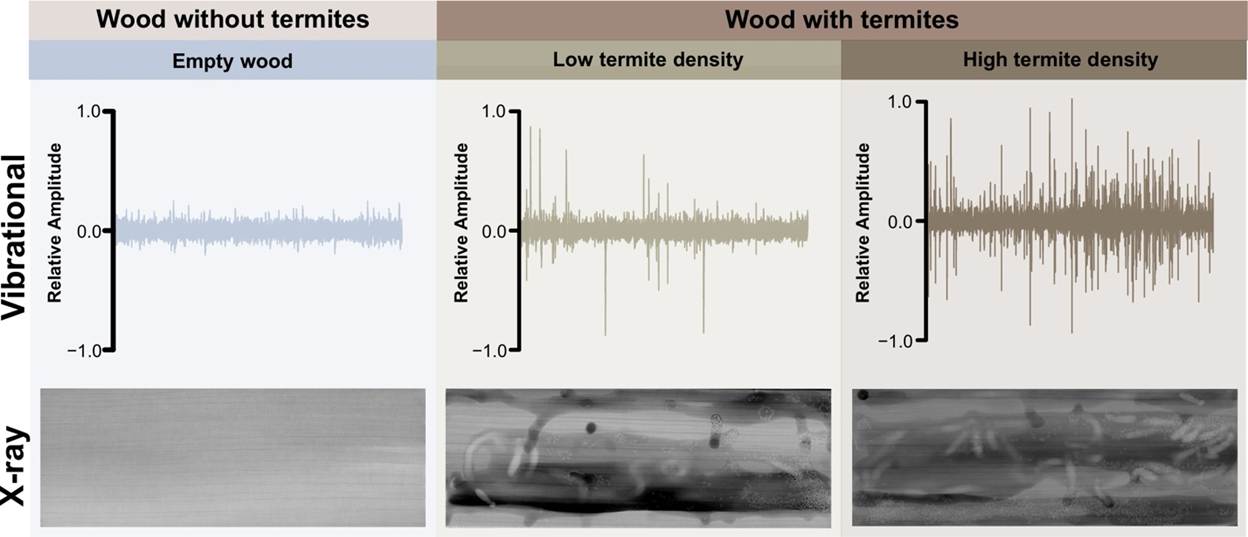 Representative waveform and corresponding radiographs of wood pieces under three termite infestation conditions: termite-free, low termite density, and high termite density.
However, important challenges remain.
Differences in wood types, environmental conditions, background noise, and termite behaviour may all affect the cues detected. Whether models developed under controlled laboratory conditions can perform reliably in naturally infested structures remains an important question for future research.
Nevertheless, this study illustrates the value of looking beyond conventional observation. By combining behavioural knowledge with vibrational sensing and machine learning, the researchers showed that activity hidden inside wood can leave measurable traces that computers can learn to recognise. For an insect that spends much of its life out of sight, those traces could be surprisingly informative.
Wood may look silent and still. Under its surface, however, termites may be moving, feeding and interacting. Sometimes, the challenge is not finding a better way to see insects. Perhaps we simply need to learn how to listen.
Do you have a paper which might work in AIE?
Royal Entomological Society Members are given discounted rates to publish in Approaches in Entomology. Please log into your account and find the code under Resources for Members if you are a member.
Want to be featured in our Journal Highlights?
Shine a spotlight on your research by submitting your papers to any of our seven journals for the chance to be mentioned on our news pages and social media
