Published: 16 November 2026.
MPs call for urgent action to protect pollinators as climate change increases threat from invasive species.
Parliamentary inquiry warns that a more proactive approach to invasive species is needed to help restore native pollinator populations and safeguard food security.
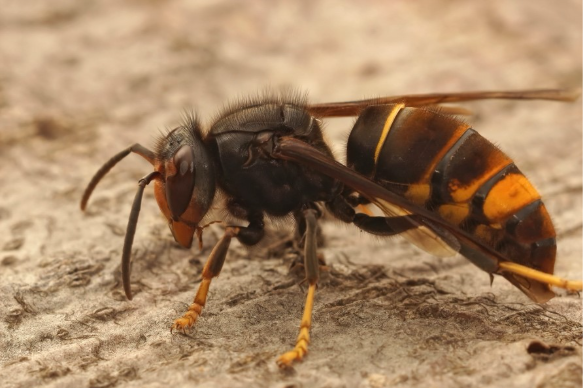 Yellow-legged (Asian) hornet (Vespa velutina)
A cross-party group of parliamentarians is warning that the UK’s island geography leaves it particularly exposed to the growing threat that invasive species pose to pollinators.
Their report is published today (16 November) by the All-Party Parliamentary Group (‘APPG’) for Bees, Pollinators and Invertebrates. The report, ‘Securing the future for UK pollinators: Preparing against the threat of invasive species’, sets out ten recommendations for a more coordinated, proactive, adaptable and resilient system for identifying and responding to invasive species. It concludes that success should be judged primarily by whether native pollinators are recovering, and not just by how many invasive species are removed or controlled.
Simon Ward, Chief Executive of the Royal Entomological Society, which acts as secretariat to the APPG, says:
“Success isn’t just about the number of invasive species detected, controlled or eradicated. It’s about healthier, diverse plant pollinator networks, and large populations of native pollinators.”
Among its ten recommendations, the APPG calls for:
- The Non-Native Species Inspectorate to be granted statutory powers to inspect trade consignments, including garden centres and plant nurseries, given that an estimated 40% of invasive species arrive through the plant and soil trade
- A time-bound process for government decisions on species presenting a significant invasive risk
- Climate-risk modelling to be prioritised, to understand which species could establish in a changing climate and where they could spread
- Clearer public information on which species pose the greatest risk and how to report sightings, with citizen-science records feeding directly into risk mapping and response planning.
The overall trend for insects in the UK is one of significant decline and the report states the arrival of invasive species that prey on, compete with or spread disease amongst native insects is part of the cause. Globally, invasive species reduce insect abundance by 31% and species richness by 26%. Insects on islands such as Great Britain and Ireland are hit harder, because their ranges are isolated and recolonising after local extinction is more difficult.
“As an island nation, we are more exposed than most. Insects on islands have isolated ranges and find it harder to recolonise after losses.”
– APPG Chair Barry Gardiner MP
The threat goes well beyond the yellow-legged hornet (also known as the Asian hornet). The report also names the harlequin ladybird, which feeds on the eggs and larvae of native insects; the varroa mite, which weakens honey bees and spreads disease; and the small hive beetle, a hive pest for which the National Bee Unit has contingency plans.
Insect pollination underpins food security and biodiversity and, as the report states, “declining numbers of pollinators compromise animal and plant health across the entire ecosystem, with associated detrimental effects on arable farming, rural communities and environmental resilience.” The wider economic burden is substantial, with the Centre for Agriculture and Bioscience International estimating that invasive species cost the UK economy £4 billion per year.
“Pollinators are the quiet infrastructure behind our crops, our hedgerows and our rural economy.”
– APPG Chair Barry Gardiner MP
Climate change adds to the pressures facing pollinators, with warmer winters helping invasive species establish and survive. The yellow-legged hornet, first recorded in the UK in 2016, was confirmed to have successfully overwintered here in 2023/24, highlighting the need for continued surveillance and rapid action.
The pressures from invasive species and climate change are compounded by other factors, including pesticide use and land-use change.
As the report puts it, “the drivers of pollinator decline compound one another; the combined effects of land use change, climate change, habitat degradation, agricultural intensification and invasive species are more complex and significant than any single driver acting alone.”
The report recommends prioritising climate-risk modelling to understand which species could establish in the UK as the climate changes, and where they might spread.
The APPG found that the 2023–2030 GB Invasive Non-Native Species Strategy is broadly heading in the right direction, and that the system works well when a threat is visible and has a clear response pathway. But the report has found that the system is less effective at preventing the steady inflow of new species. Only four species have been eradicated from Great Britain since 2008, while about 12 new non-native species establish each year.
The report identifies gaps in the UK’s response, with an extremely small team at the Non-Native Species Inspectorate and government decisions that can take too long. These weaknesses limit the system’s ability to prevent new species from becoming established or reverse the damage caused by those already widespread.
Professor Jane Stout, Professor of Ecology at Trinity College Dublin and co-founder of the All-Ireland Pollinator Plan, adds:
“It’s much easier, quicker, cheaper, to protect a habitat than it is to restore it or recreate it. It’s much better to protect a species from going extinct than it is to reintroduce it.”
As the report warns: “An effective system to identify and respond to invasive species would help our biodiversity and food systems to avoid serious disruption.”
Professor Helen Roy MBE, Principal Scientist at the UK Centre for Ecology & Hydrology and co-chair of the IPBES Assessment on Invasive Alien Species, says:
“Managing invasive species is urgent but achievable – everyone can play a part by implementing simple biosecurity actions described in campaigns such as Be Plant Wise. Insects are amazingly resilient, and they can recover, but we just need to give them that chance.”
With the government’s Pollinator Action Plan expected in early 2027, and improving and protecting pollinator health set to be one of its key focus areas, the APPG is calling on government to act on all ten recommendations. The aim is to stop new threats before they take hold and to protect the UK’s pollinators, and the food and farming that rely on them.
“Prevention is far cheaper than cure, and the window for acting is narrowing.”
– APPG Chair Barry Gardiner MP
Want more information from the Royal Entomological Society?
We have several e-newsletter groups tailored to supporters, educators, researchers and individuals generally interested in insect science. and for those interested in governance and policy.
Subscribe to one or all of these and we will keep you up to date.
ENDS
The report is based on written evidence from organisations including the British Beekeepers’ Association, Buglife, the Bumblebee Conservation Trust, the Royal Horticultural Society, Royal Botanic Gardens, Kew and the UK Centre for Ecology & Hydrology, and two oral evidence sessions held in July and September 2026.
For media enquiries, interviews and high-res images, please contact: press@royensoc.co.uk
About the All-Party Parliamentary Group for Bees, Pollinators and Invertebrates
The APPG is chaired by Barry Gardiner MP, with Lord Randall of Uxbridge, Irene Campbell MP and Mary Creagh MP as officers. The Royal Entomological Society acts as secretariat to the APPG.
About the inquiry
The inquiry gathered written evidence and held two oral evidence sessions, on 7 July and 15 September 2026, to examine the threat from invasive species and how the UK’s system could be strengthened.
Some of the species named in the report:
- Yellow-legged (Asian) hornet (Vespa velutina) – First recorded in the UK in 2016 and not yet considered established, though incursions occur regularly from continental Europe. It preys on honey bees, wasps and hoverflies, and repeated attacks cause bees to stop leaving the hive.
- Harlequin ladybird (Harmonia axyridis) – From East Asia, first recorded in the UK in 2004 and now one of the most common ladybirds. It feeds on the eggs and larvae of native insects and outcompetes native ladybirds.
- Varroa mite (Varroa destructor) – First found in the UK in 1992 and now widespread in honey bee colonies. It weakens honey bees and spreads diseases including deformed wing virus.
- Small hive beetle (Aethina tumida) – A pest that invades hives and consumes the honey, pollen, eggs, larvae and pupae inside. The National Bee Unit holds contingency plans for it.
This is not an official publication of the House of Commons or the House of Lords. It has not been approved by either house or their committees. All Party Parliamentary Groups are informal groups of members of both houses with a common interest in particular issues. The views expressed in this report are those of the Bees, Pollinators and Invertebrates APPG.
Want more information from the Royal Entomological Society?
We have several e-newsletter groups tailored to supporters, educators, researchers and individuals generally interested in insect science. and for those interested in governance and policy.
Subscribe to one or all of these and we will keep you up to date.

